
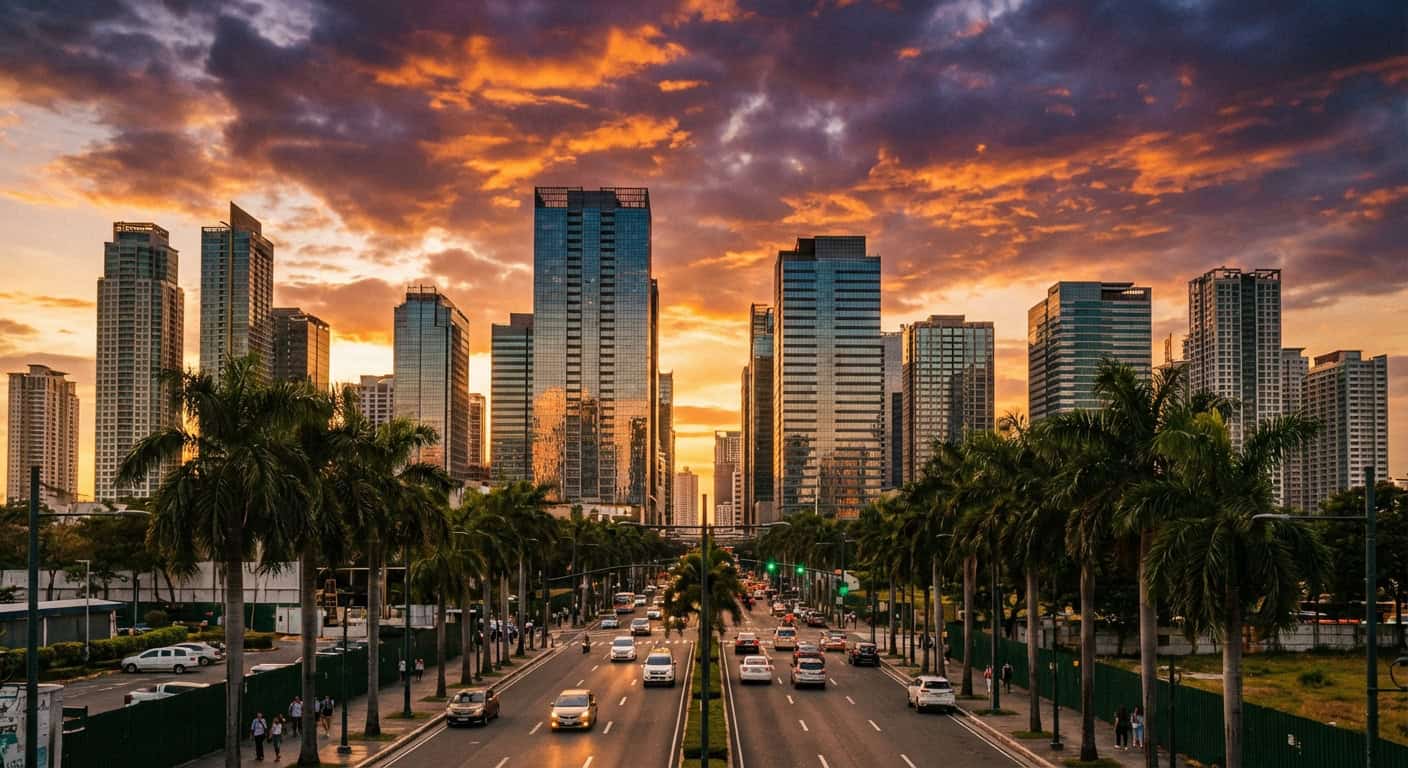
Why Manila deserves a second look
Here’s the thing about Manila that nobody in the digital nomad community wants to admit: most people skip it. They land at NINOY Aquino, immediately catch a connecting flight to Cebu or Palawan, and never give the city a chance. I get it. The beaches are the whole pitch for the Philippines. But after spending four months based in Manila, I can tell you that dismissing this city is one of the biggest mistakes nomads make in Southeast Asia.
Manila is a megacity of 14 million people. It’s chaotic, loud, and occasionally overwhelming. But it’s also the economic engine of one of Asia’s fastest-growing economies, and that means reliable internet infrastructure, a booming cafe and coworking scene, great food at every price point, and a nightlife that puts most nomad hubs to shame. If you’re building your shortlist of the best cities for digital nomads, Manila belongs on it.
The city also has something that El Nido and Siargao simply don’t: convenience. Same-day dentist appointments. Top hospitals. Any adapter, SIM card, or notarized document you need, available at a mall ten minutes away. Manila is where you come to actually run your business while the rest of the Philippines is where you go to recharge. For the full country overview, including visa logistics, start with our complete Philippines digital nomad guide. And if you’re new to the whole remote work lifestyle, our digital nomad guide covers the fundamentals.
I first came here planning two weeks before heading to the islands. I stayed four months. This guide is everything I learned.
Neighborhoods: where to base yourself
Manila is not one place. It’s a sprawl of cities stitched together into “Metro Manila,” and where you choose to live will define your entire experience. The wrong neighborhood will have you booking a flight out within a week. The right one will make you wonder why you ever bothered with Bali. Here’s the honest breakdown.
Makati: the business district with soul
Makati is where I spent most of my time, and it’s my top recommendation for nomads who want the best balance of infrastructure, food, culture, and social life. Specifically, you want to look at two micro-neighborhoods: Salcedo Village and Legazpi Village.
These “villages” are leafy, walkable pockets within Makati’s CBD. Tree-lined streets, good restaurants at every price point, weekend markets (Salcedo on Saturday, Legazpi on Sunday) where you can eat your way through Filipino, Japanese, and Mediterranean food stalls for a few dollars. Parks with actual grass. It feels nothing like the Manila you see in the movies.
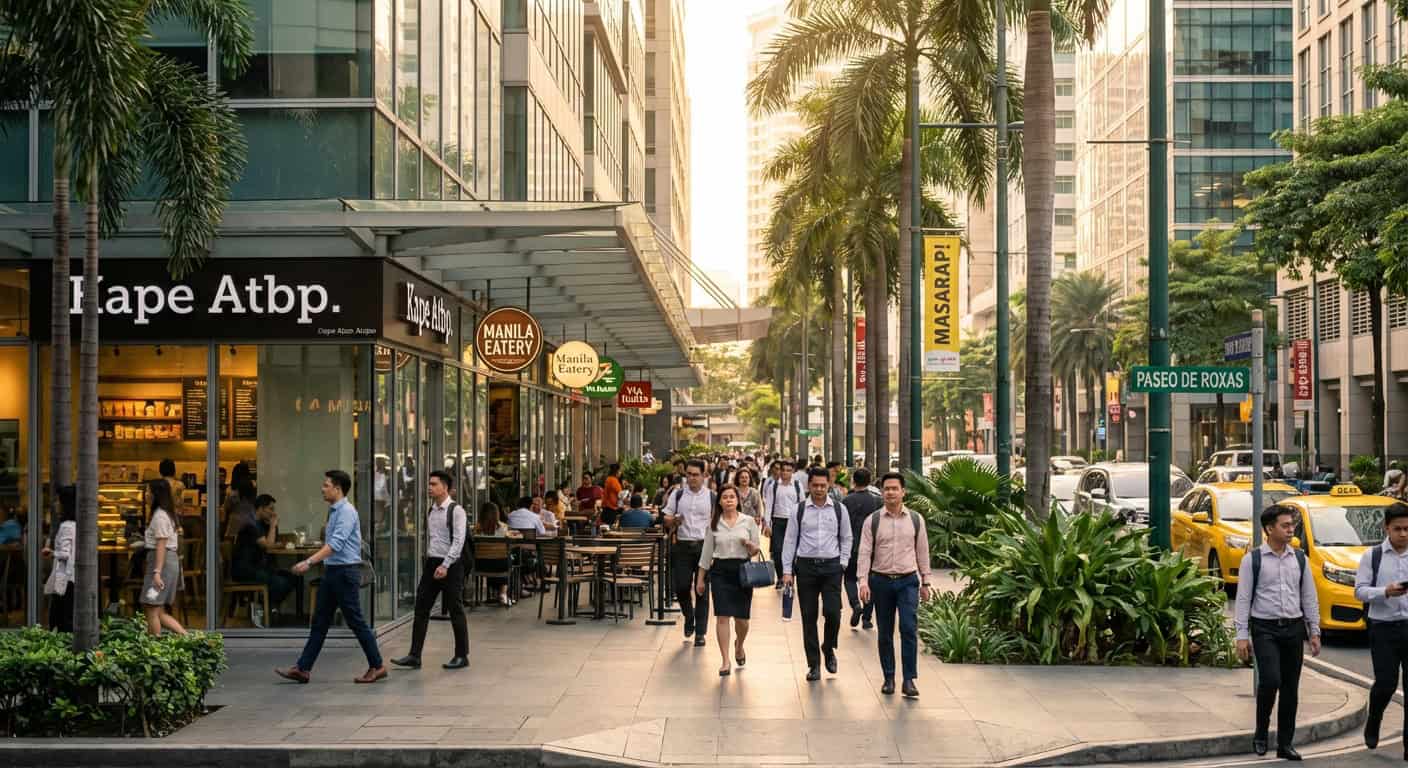
The vibe is a mix of corporate professionals, expats, and remote workers who’ve figured out that you get more “real Philippines” here than in BGC’s sanitized bubble. You’ll find jollijeeps (street food carts) next to Italian trattorias, karaoke joints next to craft cocktail bars. The contrast is part of the charm.
Rent in Salcedo or Legazpi runs about 30,000-45,000 PHP ($550-$800 USD) for a furnished studio or one-bedroom. That’s 10-20% cheaper than BGC. For the full budget picture, check out the Manila cost of living breakdown.
The downsides: flooding during heavy rain (older drainage), and walkability degrades quickly outside the village bubbles. Stay within the villages for daily life and use Grab for anything beyond.
BGC (Bonifacio Global City): the modern bubble
If Makati has soul, BGC has polish. Bonifacio Global City is Manila’s newest, most planned district, and it feels like it was airlifted from Singapore. Wide sidewalks with actual traffic enforcement. Underground power lines (meaning fewer outages during typhoons). Strict building codes. It’s clean, safe, and walkable.
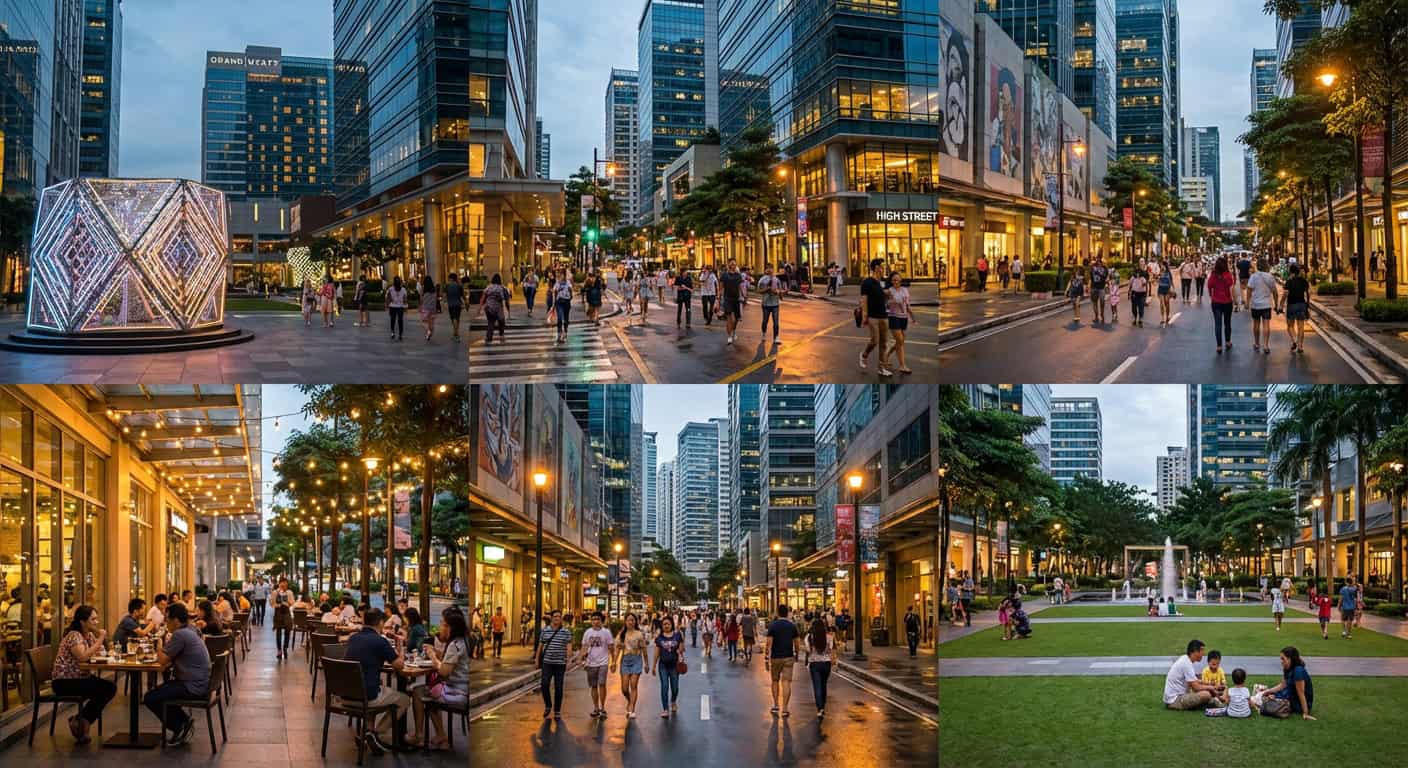
For first-timers in Manila or Asia in general, BGC is the “soft landing” neighborhood. You can walk around with your laptop at 2 AM and feel completely safe. There’s a heavy private security presence, and the area is widely described as the safest place in the Philippines. Stay near High Street or Burgos Circle for the best concentration of restaurants, cafes, and nightlife.
The trade-off is that BGC can feel sterile. One Reddit user compared it to Irvine, California: “clean, master-planned, safe, but somewhat soulless.” The restaurants lean toward international chains and upscale Filipino fusion, and everything costs a premium. A meal that costs 200 PHP in Makati will run you 350 in BGC.
BGC is the infrastructure winner though. Underground cabling means fewer power cuts, better internet reliability, and better drainage during typhoon season. If your work requires bulletproof connectivity, BGC has the edge. Rent is the highest in Manila: 40,000-60,000 PHP ($700-$1,100 USD) for a nice studio or one-bedroom.
Poblacion: the creative quarter
Poblacion is Makati’s answer to Brooklyn or Shoreditch. It’s a former red-light area that’s been aggressively gentrified over the past decade into a hipster haven of rooftop bars, craft breweries, street art, and some of the best cocktail spots in all of Manila. This is where the creative class hangs out: artists, musicians, entrepreneurs, and an increasing number of digital nomads drawn by the energy.
Here’s my honest take: Poblacion is an amazing place to spend your evenings. It is a terrible place to live if you need to be productive during the day. The noise levels are intense. Traffic is constant. The streets are narrow and chaotic. Multiple Reddit users have the same advice: visit Poblacion for the nightlife, but rent your apartment in Salcedo or Legazpi and take a short Grab ride over.
That said, if you’re someone who thrives in gritty, high-energy environments and your work schedule is flexible, Poblacion has some of the cheapest rent in the Makati area and puts you at the epicenter of Manila’s social scene. Just know what you’re signing up for.
Ortigas: the budget play
Ortigas is Metro Manila’s “third business district” and the option that rarely makes nomad recommendation lists. It’s cheaper than both Makati and BGC, has massive malls (SM Megamall is genuinely enormous), decent condos, and reasonable internet. Some nomads on a tighter budget base themselves here and it works fine.
The honest assessment: Ortigas lacks the character of Makati and the polish of BGC. It’s a functional place to live, not an exciting one. Traffic in and out is notoriously bad. If you’re staying long-term and optimizing purely for cost, it’s worth considering. For a month or two? Spend the extra money and live where the action is.
Internet and connectivity
This is the section that actually determines whether you can work here. The good news: Manila’s internet has improved dramatically in recent years, and in the right setup, it works well.
Fiber is king. The two main providers are Converge and PLDT Fibr. In a condo with fiber, you’ll typically see 100-300 Mbps download speeds. Zoom calls are smooth. Large file uploads are manageable. When I tested apartments before signing, any place with Converge fiber consistently delivered solid speeds.
The backup rule. Every experienced nomad in Manila follows this: always have a backup internet source. If your apartment runs on PLDT, buy a Smart SIM card as your mobile hotspot backup. If you’re on Converge, get a Globe SIM. Different providers use different infrastructure, so if one goes down, the other stays up. SIM cards with data plans are cheap.
Mobile data warning: Do not rely solely on mobile hotspots for critical work. While 5G exists (Smart tends to outperform Globe), thick concrete condo walls can kill your signal. Mobile data is your backup, not your primary connection. Our guide to staying productive on the road covers backup connectivity strategies in depth.
Workspaces: where to get things done
Manila has a busy workspace scene, from dedicated coworking spaces to laptop-friendly cafes scattered across Makati and BGC. I’ve written a full deep dive covering the best coworking spaces and cafes in Manila with wifi speeds, pricing, and honest reviews for each one.
The short version: Acceler8 is the most frequently recommended coworking space in the nomad community, with locations in both Makati and BGC. It’s praised for reliable internet, a community vibe, and events that actually bring people together. KMC Solutions is more corporate but rock-solid on infrastructure. WeRemote is another solid option.
For cafe workers, Makati’s Legazpi and Salcedo areas are dense with options. In BGC, the concentration of third-wave coffee shops around High Street and Uptown is excellent. A word of caution from the local nomad community: some independent cafes turn off wifi on weekends to discourage laptop camping. Weekdays are generally better for cafe-based work sessions.
Cost of living: the quick overview
Manila sits in an interesting spot on the cost spectrum. It’s significantly cheaper than Singapore or Hong Kong, roughly on par with Bangkok for similar quality of life, and more expensive than Vietnam or Cambodia. The Philippines’ high electricity costs (among the highest in Asia) are the budget surprise that catches most newcomers off guard.
At $1,500-$2,000 USD per month, you’ll live very comfortably. Nice condo in Makati or BGC, eating out daily, regular cafe sessions, weekend activities, gym membership. The Reddit expat community describes this as an “upper-middle class” budget that covers everything without stress.
At $1,000-$1,200, you can make it work but you’ll be making trade-offs: smaller apartment, more local food, fewer nights out.
The thing that will make or break your budget is your air conditioning habits. Electricity bills can hit 10,000-13,000 PHP ($180-$230 USD) per month if you run AC around the clock. That’s a line item that doesn’t exist in the same way in cooler nomad cities. For the complete line-by-line breakdown of rent, food, utilities, and everything else, head over to the Manila cost of living guide.
Healthcare and safety
Healthcare in Manila is good and affordable, which is one of the city’s underrated advantages. You have access to top hospitals at a fraction of Western prices.
St. Luke’s Medical Center (with locations in BGC and Quezon City) is the gold standard. International-level care, English-speaking specialists, modern facilities. It’s expensive by Philippine standards but still far cheaper than anything comparable in the US, Europe, or Australia.
Makati Medical Center is centrally located in Makati’s CBD and good for both routine and serious medical needs. If you’re based in Makati, this is your go-to.
For minor issues (colds, stomach bugs, allergies) skip the hospital and walk into a Mercury Drug pharmacy. They’re on every other block, well-stocked, and the pharmacists can recommend treatments for most common ailments over the counter.
On safety: Manila’s reputation is worse than its reality, but you do need to be smart. The expat community is unanimous on this: BGC and the Makati villages are safe. You can walk around BGC at 2 AM with your laptop and feel fine. Makati’s Salcedo and Legazpi villages are similarly secure, though they get quiet late at night.
Outside these bubbles, the city changes quickly. Keep your phone in your pocket near roads (motorcycle snatchers are real). Don’t flash expensive jewelry. Use Grab instead of walking long distances at night. Avoid areas like Tondo, and exercise caution in Malate and Ermita after dark. Our travel safety fundamentals guide covers the essentials, and if you’re arriving solo for the first time, the street-smart advice applies doubly here.
Common scams: overly friendly strangers at Rizal Park inviting you to “cultural events” (often a drugging scam), taxi drivers refusing the meter, and airport “helpers” who grab your bags and demand payment. Download Grab before you leave the airport and you’ll sidestep most of these.
The social scene
Let me be straight with you: Manila is not Chiang Mai. There’s no tight-knit nomad village where you bump into the same people at the same three cafes every day. Manila is a megacity, and meeting people requires actual effort. But the upside of that effort is real: the people you connect with here tend to be more diverse, more established, and more interesting than the typical backpacker-turned-nomad crowd.
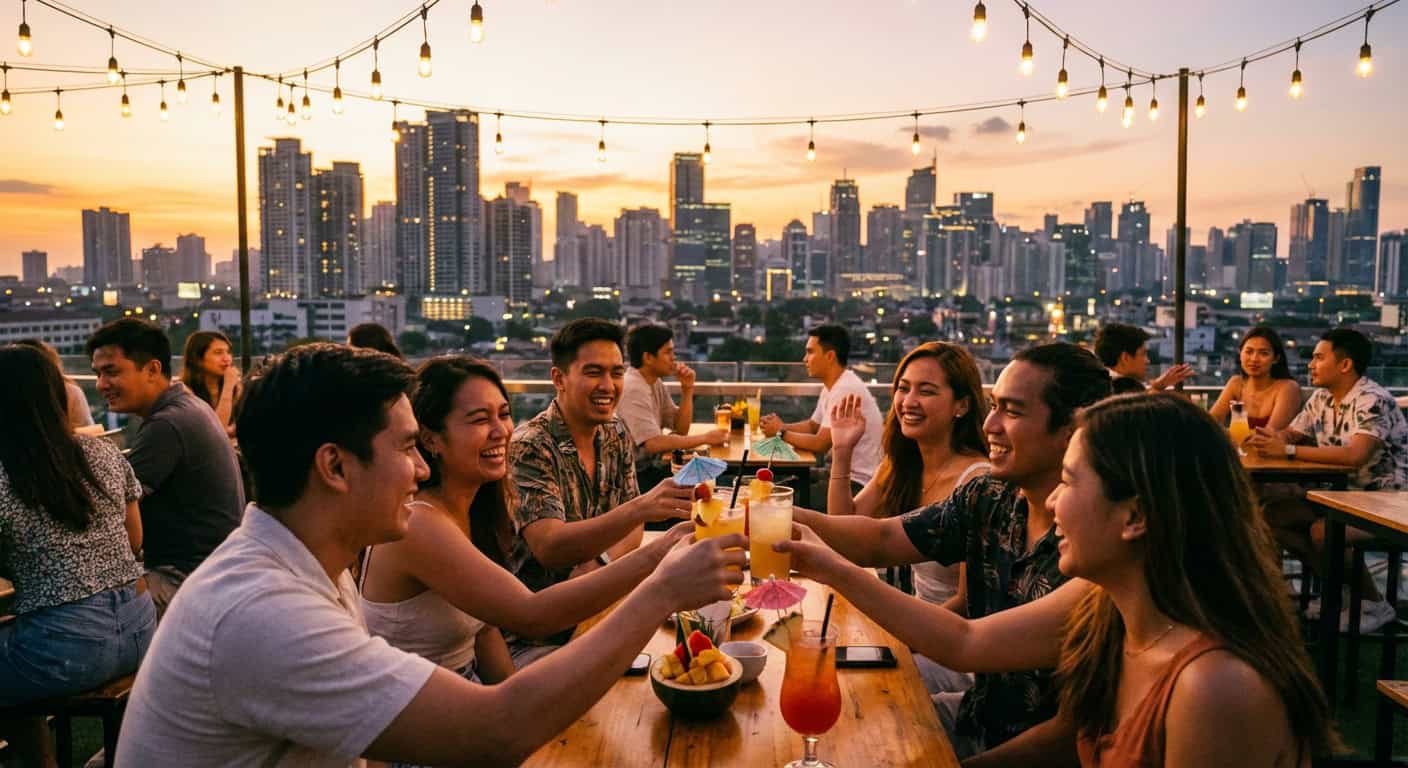
Start with coworking spaces. Acceler8 hosts regular events that are good for meeting other remote workers. The “Digital Nomad Philippines” Facebook group organizes in-person gatherings. Bumble BFF is surprisingly popular here for making platonic friends. Locals are incredibly friendly and almost universally English-speaking, which drops the social barrier dramatically.
Poblacion is the go-to for social nightlife, even if you live in BGC. Rooftop bars, live music, craft cocktails. Conversations happen easily because everyone’s packed into small, interesting spaces. If building your nomad community is important to you, make Poblacion your weekend home base.
HitchHive is another way to connect with fellow travelers and digital nomads in Manila. I’ve found that the shared experience of navigating Manila’s controlled chaos together creates bonds that stick. The city rewards people who put themselves out there. If you’re looking for a coworking buddy, a weekend travel partner, or just someone to explore Poblacion’s bar scene with, check out our guide on how to find travel buddies.
Getting around
Let me deliver the hard truth first: Manila traffic is among the worst in the world. This is not an exaggeration. A 3-kilometer Grab ride from Makati to BGC can take 45 to 90 minutes during rush hour (roughly 5 PM to 8 PM). The universal advice from every expat and local is simple: live where you plan to spend most of your time. Do not plan on commuting between neighborhoods daily.
Grab is your primary mode of transport. It works like Uber, it’s safe, and it’s reasonably priced (except during surge pricing at rush hour). This is how you should get around at night and for any trip longer than walking distance.
The MRT/LRT (metro rail) exists and is cheap, but notoriously overcrowded during peak hours. Useful for specific routes, not a daily commute solution for most nomads.
Motorcycle taxis (Angkas, JoyRide) are the cheat code for beating traffic. They weave through gridlock and can cut a 60-minute car trip to 15 minutes. You’re on the back of a motorbike in Manila traffic, which isn’t for everyone, but it’s the fastest way to move around the city.
Walking is viable within BGC and the Makati village bubbles. Beyond those zones, sidewalks either don’t exist or are occupied by vendors and construction. Manila is fundamentally a vehicle city.
Manila vs. Cebu: a quick comparison
If you’re choosing between Manila and Cebu, here’s the honest comparison. Manila is the urban powerhouse: better infrastructure, more workspace options, stronger internet, better nightlife, and access to top healthcare. Cebu is the lifestyle play: beaches within reach, a more relaxed pace, island hopping on weekends, and a smaller (but tight-knit) nomad community.
Many long-term Philippines nomads split their time: a month or two in Manila getting things done, then a month in Cebu to decompress. It’s a rhythm that works well within the Philippines as a whole.
Exploring Manila: beyond the laptop
Manila is one of those cities where the things that make it frustrating also make it fascinating. On your days off, take the time to explore.
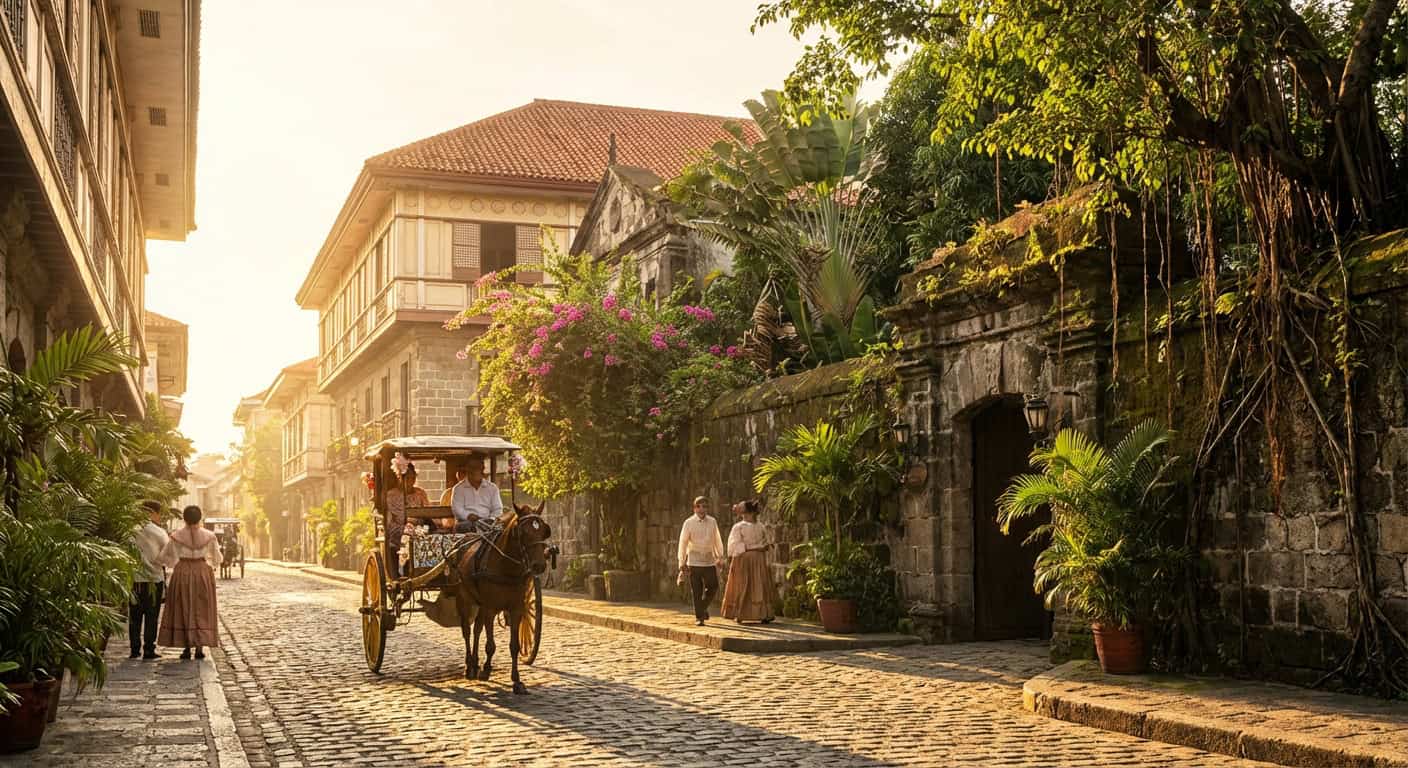
Intramuros, the old walled city built by the Spanish in the 1500s, is a compelling historical site. Walk the walls, visit San Agustin Church, eat at Barbara’s Heritage Restaurant. It’s a completely different Manila from the glass towers of BGC. Binondo, Manila’s Chinatown (the oldest in the world), is a sensory overload of street food, Chinese-Filipino fusion restaurants, and chaotic markets that’s worth at least a full day of exploration.
I’ve put together a dedicated guide covering the best things to do in Manila for digital nomads looking to make the most of their weekends and downtime without blowing their budget or their energy for Monday morning.
And don’t forget the airport advantage: Manila puts you a one-hour flight from some of the best islands in the world. Palawan, Boracay, Siargao, Bohol — they’re all quick weekend trips from NAIA. That combination of urban base and island access is something very few cities can match.
Continue your journey
If you’re planning your Manila chapter, these guides will help you hit the ground running:
- Best Coworking Spaces and Cafes in Manila — tested wifi, pricing, and honest reviews
- Manila Cost of Living for Digital Nomads — month-by-month budget breakdown
- Things to Do in Manila on Your Days Off — weekend adventures and local favorites
- The Digital Nomad Guide to Cebu — the island alternative for remote workers
Find your people in Manila
Manila is the kind of city that reveals itself slowly. The first week might frustrate you. The second week, you’ll start to see the rhythm. By the end of the first month, you’ll understand why so many nomads who came for two weeks ended up staying for six months. It’s a city that rewards persistence, curiosity, and the willingness to look past the surface.
If you’re heading to Manila, or you’re already on the ground and looking for your crew, use HitchHive to connect with other digital nomads and travelers in the city. Whether you need a coworking partner, someone to explore Intramuros with, or a crew for Saturday night in Poblacion, the right people make every city better. And in a megacity like Manila, having your people is what turns a chaotic city into home.
Leave a Reply