
My first encounter with Sichuan spice
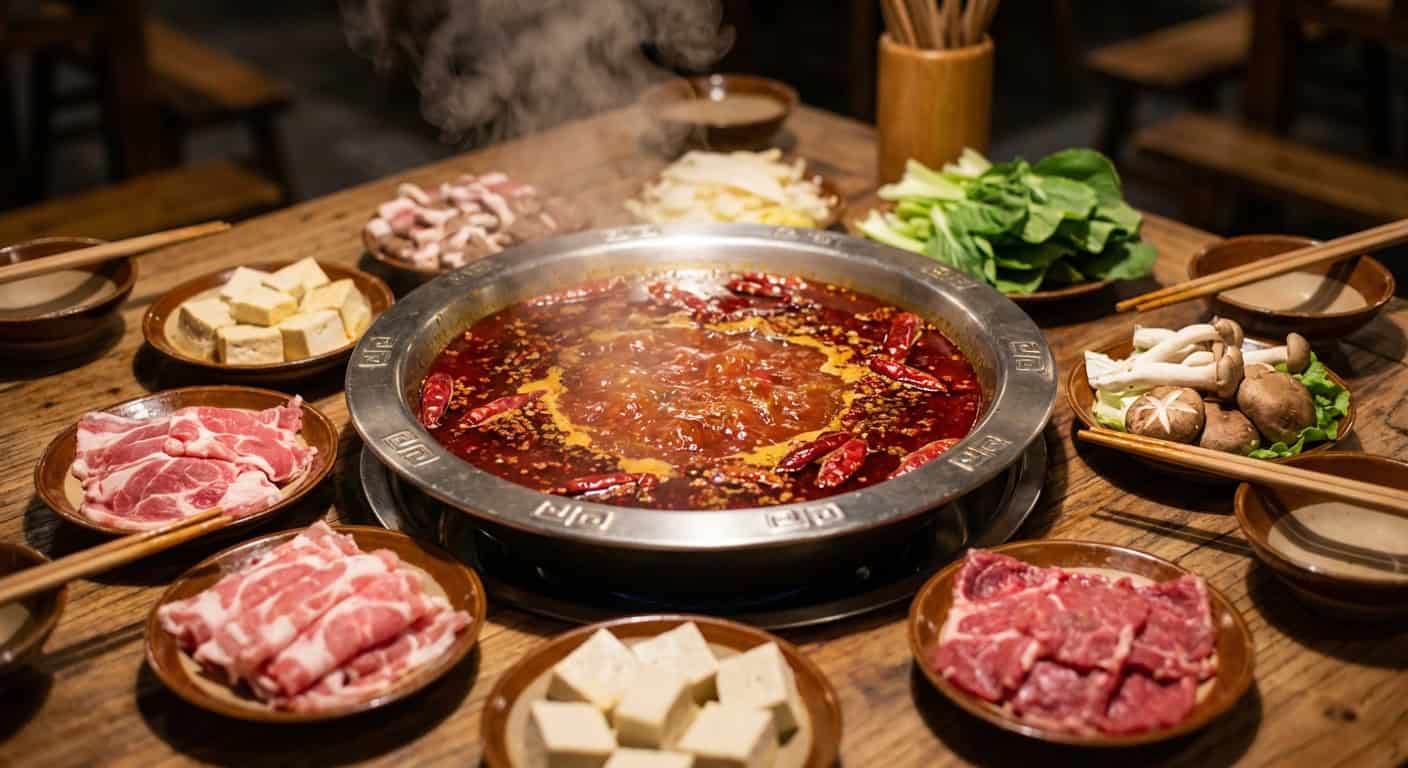
I thought I knew spicy food. I’d eaten my way through Thailand, survived vindaloo in Goa, and never flinched at a habanero. Then I sat down at a small hot pot place in Chengdu’s Yulin neighborhood, dipped a slice of beef into a bubbling red broth, and my entire mouth went numb. Not burning, not painful, just numb. My lips tingled. My tongue forgot how to work. The guy next to me, watching me try to form words, just laughed and slid over a bottle of soy milk.
That was my introduction to ma la, the two-character flavor profile that defines Chengdu’s food. Ma is the numbing tingle from Sichuan peppercorns. La is the heat from dried chilies. Together they create something I’d never experienced before, and something that kept me in Chengdu weeks longer than I’d planned. If you’re putting together a list of the best cities for food travel, Chengdu belongs at the top. This is a city where the locals eat out for nearly every meal, where a bowl of noodles at 7 AM can rearrange your understanding of flavor, and where the question isn’t whether you’ll eat well but how much your taste buds can handle.
Here’s everything I learned about eating in Chengdu, from hot pot etiquette to the best street food spots that locals actually go to.
Hot pot: the heart of Chengdu dining
Hot pot is the communal meal that Chengdu revolves around. You sit around a table with a bubbling pot of broth, order raw ingredients, and cook them yourself at the table. It sounds simple. It is simple. And yet somehow it turns every meal into a two-hour event where the food keeps coming and nobody wants to leave.
Chengdu hot pot comes in a few configurations. The full red pot (hong guo) is a lake of chili oil, dried peppers, and Sichuan peppercorns. It’s intense. If you’re not sure about your spice tolerance, order a yuan yang guo, which is a split pot with one spicy side and one mild side (usually tomato or mushroom broth). Nobody will judge you for this. Even locals who grew up on the stuff use the mild side to give their mouths a break.
Ordering works like this: your server brings a menu (usually with pictures, sometimes only in Chinese), and you pick raw ingredients that arrive on plates. Thin-sliced beef, lamb, tripe, mushrooms, tofu, lotus root, leafy greens, potato slices, quail eggs. You drop them into the broth, wait a minute or two depending on the item, fish them out, and dip them in a sauce you mix yourself at the sauce bar. The standard dip is sesame oil with crushed garlic, which also helps cool the burn.
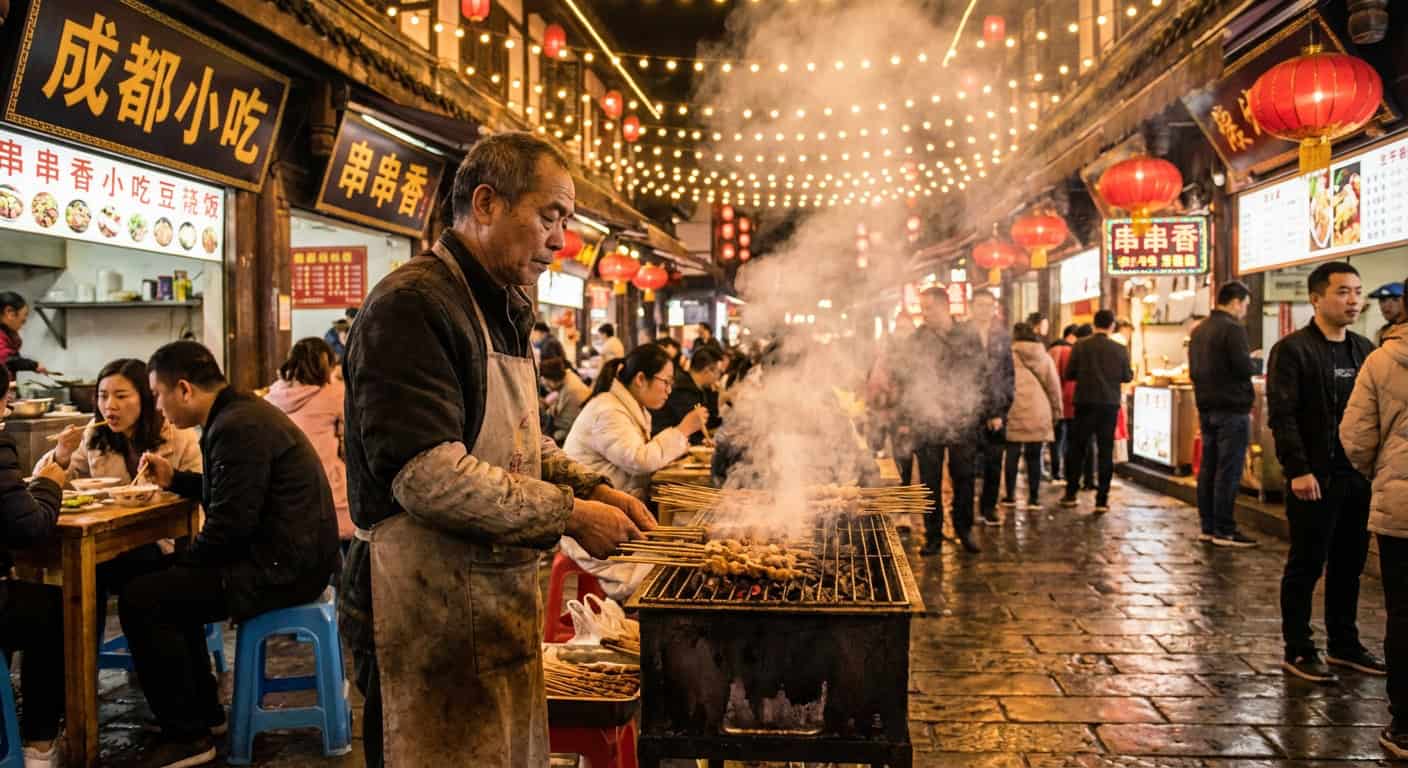
For specific places, Reddit travelers and locals recommend a few reliable spots. XiaoLongKan is a famous chain with locations across the city that has picture menus and decent English support, making it a solid first hot pot experience. Da Long Yi is a local favorite known for being seriously spicy. Shu JiuXiang is a classic that’s been around for years and still delivers consistent quality. Yuanli is a newer option with a nicer atmosphere if you want something a step above plastic stools. For a different vibe, Malu Bianbian does skewer hot pot (chuan chuan), where you pick pre-skewered ingredients and dip them in the communal pot. It’s loud, chaotic, and fun.
A full hot pot meal for two people costs 100 to 200 RMB (about $14 to $28 USD) at most local places, including drinks. Fancier chains like Jincheng Impression run higher, but even “high-end” hot pot in Chengdu is cheap by any Western standard. If you’re tracking your spending, our Chengdu budget travel guide covers meal costs in detail.
Street food you can’t skip
Hot pot gets the headlines, but Chengdu’s street food is where the real daily eating happens. These are the dishes locals grab on the way to work, eat standing on the sidewalk, or order as late-night snacks after too many beers.
Chuan chuan (skewers) are everywhere. Meat, vegetables, and tofu threaded onto bamboo sticks and either grilled over charcoal or simmered in spicy broth. You pick your sticks from a cooler, hand them over, and pay by the stick. Most sticks cost 1 to 3 RMB each, so you can eat a full meal’s worth of skewers for 20 to 30 RMB.
Bo bo ji (cold pot skewers) is a variation worth seeking out. Pre-cooked skewers sit in a room-temperature spicy broth. You grab what looks good, eat it cold, and pay by the stick at the end. It’s different from hot pot because everything is already cooked and the broth is room temperature, making it more of a snack than a full meal.
Rabbit head is the dish that separates the adventurous from the cautious. Chengdu consumes more rabbit than almost anywhere else in China, and rabbit heads are a local snack. They come spicy or five-spice flavored, and you crack them open and pick out the meat. Reddit travelers call it “more work than meat” but worth trying once for the experience. You’ll find them at street stalls and in convenience stores.
Other street food to look for: guokui (crispy meat-filled flatbread, especially good on Jianshe Road), tang you guo zi (fried sticky rice balls coated in brown sugar, completely non-spicy), dan hong gao (egg pancakes), and bing fen (ice jelly), which is the sweet, cold dessert locals eat to put out the fire after a spicy meal. Bing fen costs 5 to 10 RMB and you’ll find it at nearly every street food cluster.
The classic Sichuan dishes
Beyond hot pot and street snacks, Chengdu’s sit-down restaurants serve a lineup of Sichuan dishes that you’ll recognize by name but won’t recognize by taste. The versions served here are different from what you’ve had at Chinese restaurants back home.
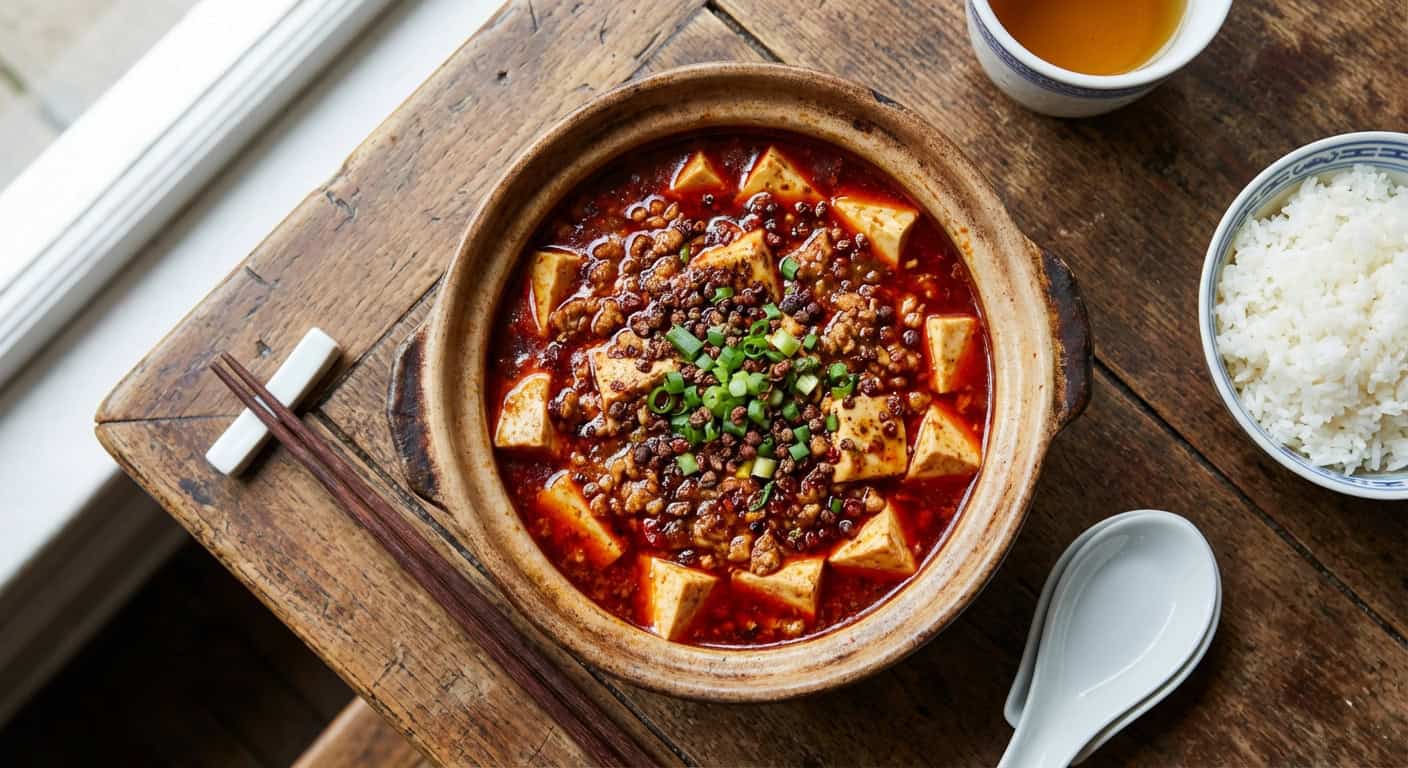
Mapo tofu is the one dish everyone tells you to eat at Chen Mapo Tofu, the restaurant that claims to have invented it. The original location is on Qinghua Road. The dish is soft tofu in a sauce built on doubanjiang (fermented broad bean paste) and douchi (fermented black beans), with ground beef, chili oil, and a heavy dusting of ground Sichuan peppercorn on top. It is oily, deeply savory, and aggressively numbing. The food experiences you have at places like this stick with you in a way that Michelin-star meals sometimes don’t.
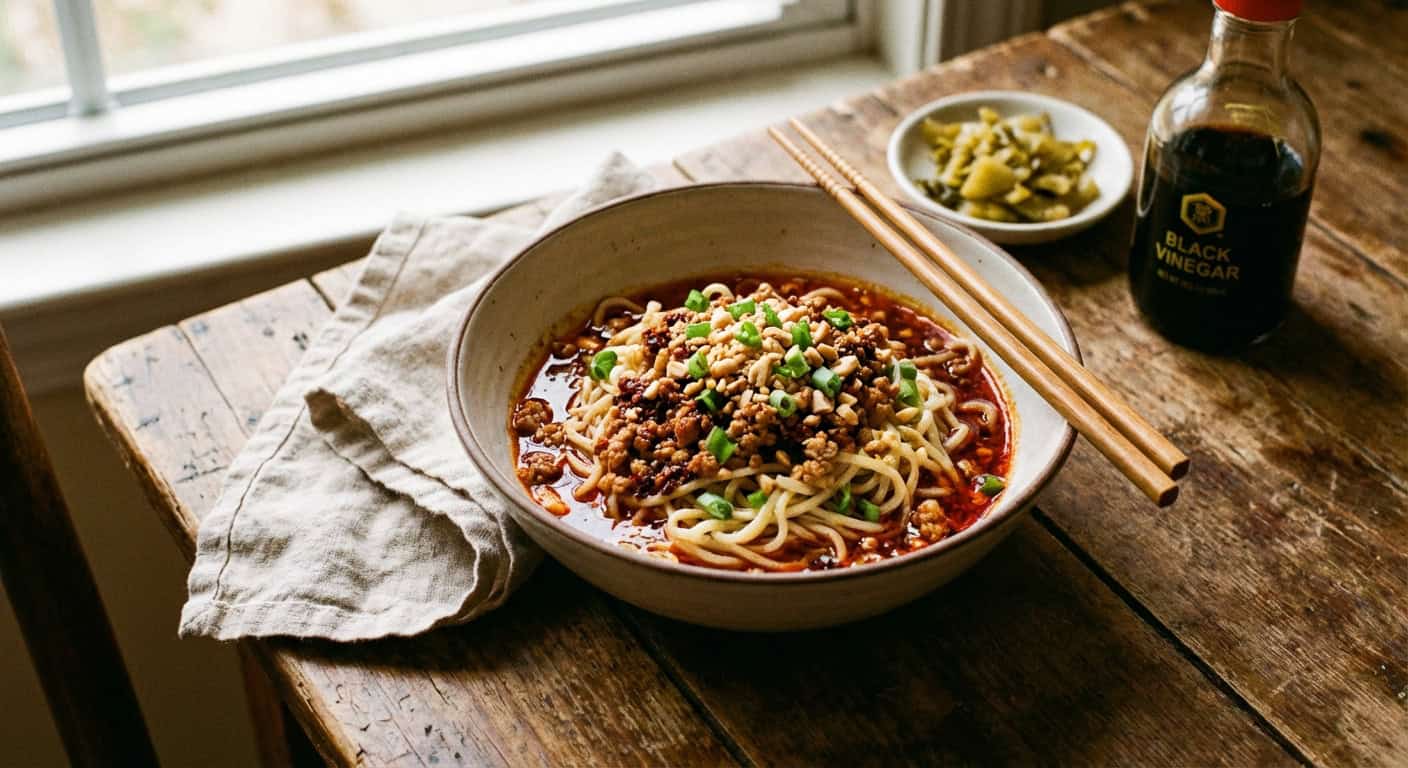
Dan dan noodles are Chengdu’s answer to fast food. Thin wheat noodles served in a small bowl with chili oil, ground pork, preserved mustard greens (yacai), crushed peanuts, and Sichuan pepper. The authentic version has very little broth. You mix everything together at the table and eat it in about five minutes. A bowl costs 8 to 15 RMB. If your dan dan noodles have a thick peanut butter sauce, you’re eating the Americanized version, not the real thing. The Chengdu original is drier, oilier, and sharper.
Hui guo rou (twice-cooked pork) is sometimes called the king of Sichuan dishes. Pork belly is boiled, sliced thin, then wok-fried with doubanjiang, garlic leeks (suan miao), and fermented black beans. The authentic version uses garlic leeks, not cabbage. Look for it at fly restaurants (more on those below) or at Chen Mapo Tofu, which serves solid versions of the classics beyond just tofu. Zuzhi Xiangnan is another spot specifically recommended for this dish.
Gong bao ji ding (kung pao chicken) in Chengdu is completely different from the sweet, gloopy takeout version. Here it’s diced chicken wok-fried with dried red chilies, Sichuan peppercorns, and peanuts. It’s dry, crispy, and intensely fragrant. Other dishes worth ordering: yu xiang qie zi (fish-fragrant eggplant, which contains no fish), fuqi feipian (thinly sliced beef and offal in chili sauce, served cold), and shui zhu niu rou (beef poached in a pool of searingly hot chili oil that you eat out of, not drink).
Understanding ma la
If you’re going to eat in Chengdu, you need to understand what’s happening in your mouth. Ma la is two distinct sensations. La is the burning heat from chili peppers, the kind you already know. Ma is the numbing, buzzing, almost electric feeling from Sichuan peppercorns. They look like small reddish-brown husks, and when you bite into one, your lips and tongue go tingly. Some people describe it as a mild anesthetic. It’s strange the first time, and then you start craving it.
The combination works because the numbness takes the edge off the heat, letting you eat spicier food than you normally could. Chengdu locals have been building tolerance since childhood, so their “mild” is your “help me.” If you’re ordering and want to dial it back, say “wei la” (micro spicy). Be warned that Chengdu micro-spicy can still make you sweat. If you truly can’t handle any spice, say “bu la” (not spicy), though even then a few peppercorns might sneak in.
Soy milk (dou nai) is the local fire extinguisher. Most hot pot restaurants sell it by the bottle, and it coats your mouth and stomach better than water. Beer also works, which is convenient because Chengdu’s hot pot culture and beer culture overlap almost completely. Rice is another buffer. Many spicy restaurants serve plain steamed rice or egg fried rice alongside the main dishes specifically for mixing with the oily, spicy sauces. Our travel safety guide covers food safety basics, but the honest truth about Chengdu is that the biggest risk to your wellbeing is ordering the full-spice hot pot on your first night.
Where to eat: the neighborhoods and streets
Where you eat in Chengdu matters as much as what you eat. The city has distinct food neighborhoods, and the gap between tourist zones and local spots is wide.
The Yulin neighborhood is the most frequently recommended area for food. It’s a grid of older residential streets packed with small restaurants, hot pot joints, barbecue spots, and late-night noodle shops. This is where locals eat after work, and the density of good food per block is hard to beat anywhere. Just walk around, look for the places packed with people, and sit down. If you’re exploring the city between meals, our guide to things to do in Chengdu covers the best non-food activities in each district.
Jianshe Road is the go-to street for snacks. Guokui vendors, skewer stalls, noodle shops. It’s busy, loud, and the food is cheap. Kuixing Lou Street, near Kuanzhai Alley, is another solid food street that locals prefer over the tourist alleys themselves.
For night markets, skip the often-cited Yulin Night Market (which isn’t what it used to be) and head to Fuqin Night Market instead. It’s in a residential area, so it shuts down by 10 PM, but between 6 and 9 PM it’s packed with stalls selling grilled skewers, noodles, and snacks. Get there early.
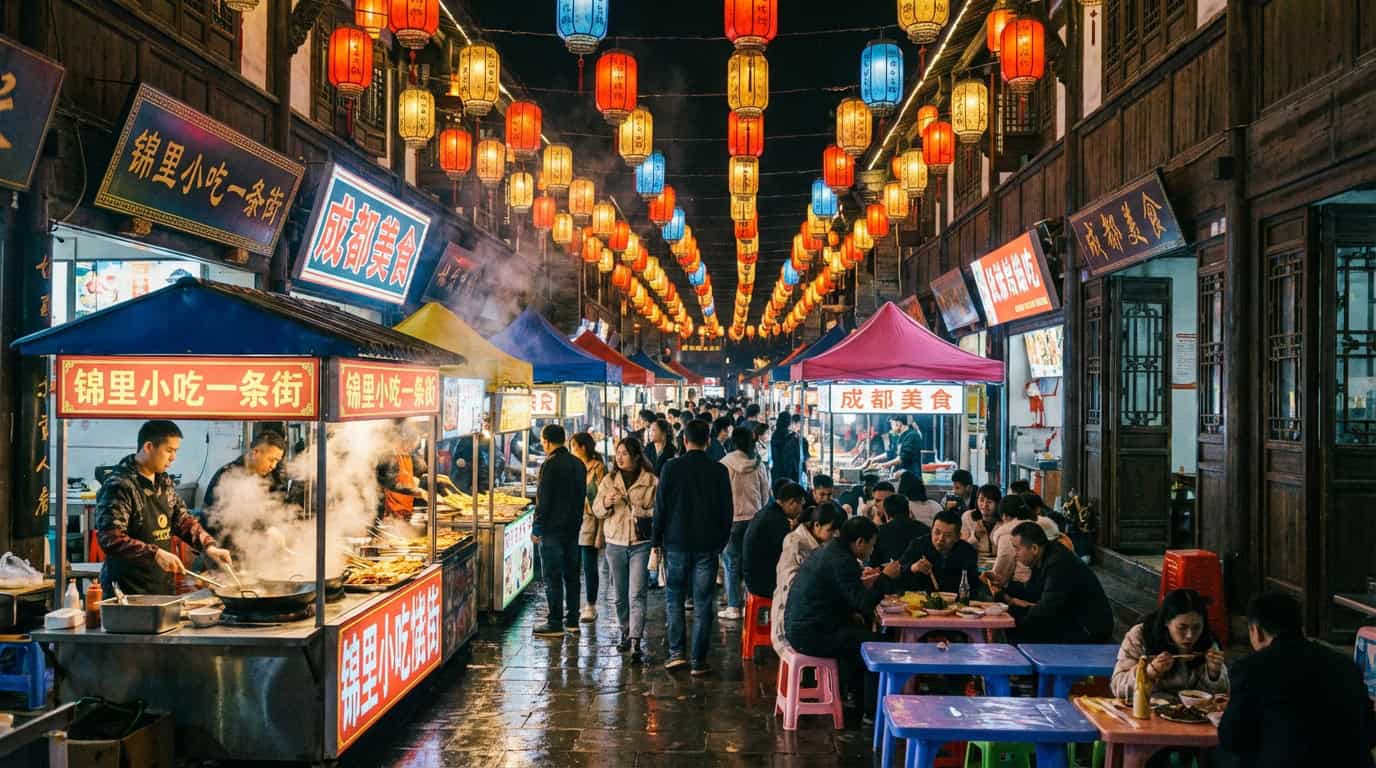
A warning about Jinli Ancient Street and Kuanzhai Alley: they’re worth visiting for the architecture and atmosphere, but the food is overpriced and mediocre compared to what you’ll find in actual neighborhoods. Walk through, take photos, maybe grab a single snack, but eat your real meals elsewhere. The underground food floors of malls near Chunxi Road (especially Silver Mall) are a better bet for central dining than the surface-level tourist traps.
For fly restaurants (cangying guan), those famously dirty, tiny, and delicious hole-in-the-wall spots, look around the Wuhou Shrine area and in the older residential alleys. If you see plastic stools, no English menu, and a line of locals, you’ve found one. Ming Ting Restaurant is often cited as the most famous fly restaurant in Chengdu, though it’s gotten popular enough that “fly restaurant” is generous. It’s still a solid starting point.
Ordering food and eating etiquette
Ordering in Chengdu is straightforward once you know the system. At most local restaurants, you’ll get a paper menu (sometimes just a sheet with checkboxes), mark what you want, and hand it to your server. At hot pot places, the process is the same but with a longer ingredient list. Larger chains like XiaoLongKan and Shu JiuXiang have picture menus. At fly restaurants and small noodle shops, you might need to point at what other tables are eating or use your phone’s translation app.
Download Dianping before you arrive. It’s the Chinese equivalent of Yelp and Google Maps combined. Even if you can’t read Chinese, the photos, ratings, and map feature help you find highly-rated spots near your location. Meituan is another useful app for finding food and ordering delivery.
Tipping doesn’t exist in Chengdu. Don’t leave money on the table. Payment is almost entirely through WeChat Pay or Alipay. Cash is accepted at most places but increasingly rare. Getting WeChat Pay set up as a foreigner can be tricky, so sort it out before you arrive or carry small bills as backup. Connecting with other travelers through HitchHive is a good way to get tips on navigating the payment apps, since people who’ve recently figured it out can walk you through the process.
At hot pot, don’t double-dip your chopsticks. Use the communal chopsticks (usually longer than your personal pair) to put raw food into the pot, and your personal chopsticks to eat. Thin meats cook in 15 to 30 seconds. Thicker items like potato and lotus root need a few minutes. If something is floating, it’s probably done.
Eating well on a budget
Chengdu is one of the cheapest major food cities in the world. A bowl of dan dan noodles costs 8 to 15 RMB ($1 to $2). Street food snacks run 5 to 15 RMB per item. A full hot pot dinner for two at a local spot costs 100 to 200 RMB ($14 to $28). Even at a nicer restaurant, ordering four dishes and rice for two people rarely exceeds 150 RMB ($21).
The cheapest eating strategy: noodles and street food for breakfast and lunch, hot pot or a sit-down restaurant for dinner. You can eat three full meals a day for 50 to 80 RMB ($7 to $11). That’s not deprivation eating. That’s good food, every meal, in a city that takes its role as one of the world’s great food travel destinations seriously. For more ways to stretch your budget in China and elsewhere, our budget travel hacks guide covers the basics.
Fly restaurants are your best friend for cheap sit-down meals. A plate of hui guo rou with rice at a hole-in-the-wall costs 15 to 25 RMB. A bowl of noodles at Laochengdu Sanyang Mian runs about 12 RMB. The food at these places is often better than what you’d get at a restaurant charging three times the price. If you’re backpacking through Chengdu, you can eat like a king on a backpacker budget.
One more tip: the shared experience of a hot pot meal gets cheaper with more people. Hot pot is priced by ingredients, not per person, so splitting a pot with three or four travelers means everyone eats well for less. It’s also more fun. Some of the best meals I had in Chengdu were with people I’d met at my hostel that morning and convinced to come eat with me that night.
Continue your journey
If you’re planning a trip to Chengdu, these guides will help you get the most out of your visit:
- The Backpacker’s Guide to Chengdu — logistics, neighborhoods, and getting around on a budget
- Things to Do in Chengdu — pandas, teahouses, temples, and day trips beyond the food
- Day Trips from Chengdu — Leshan Giant Buddha, Jiuzhaigou, and mountain escapes
- Chengdu Budget Travel Guide — full cost breakdown for accommodation, transport, and meals
- The Best Cities for Culinary Travel — how Chengdu stacks up against the world’s top food destinations
Leave a Reply