
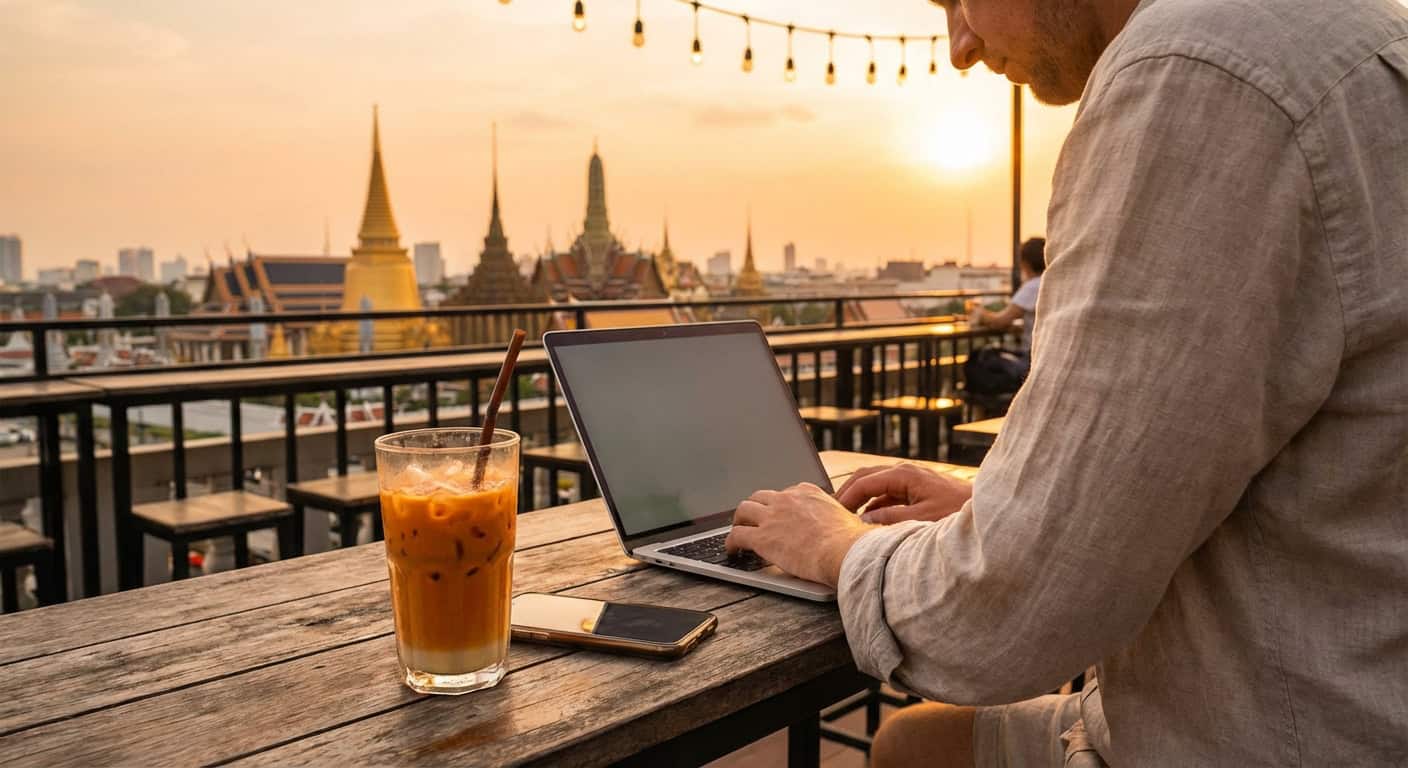
Thailand finally gets it
For years, Thailand was the paradox of the digital nomad world. Everyone wanted to live there. The infrastructure was excellent, the food legendary, the cost of living unbeatable, and the communities in Chiang Mai and Bangkok were the biggest in Southeast Asia. But the visa situation was a disaster. You were either on a 60-day tourist stamp doing border runs every two months, paying $25,000 for the Elite Visa, or enrolled in a Thai language school you never attended. Then, in mid-2024, Thailand launched the Destination Thailand Visa, and the game changed overnight.
The DTV is, by community consensus, the best digital nomad visa in Southeast Asia. Five-year validity. 180-day stays per entry. About $300 USD. I’ve held one since early 2025, and it’s transformed how I think about basing myself in Thailand. No more visa anxiety. No more border run math. No more pretending to study Thai at a visa mill. This guide covers every detail you need to get one and live on it.
If you’re comparing Thailand against other Southeast Asian destinations, start with the complete SE Asia visa guide for the big picture, then come back here for the Thailand deep dive.
What is the DTV?
The Destination Thailand Visa is a 5-year multiple-entry visa designed for remote workers, freelancers, and people enrolled in Thai “Soft Power” activities like Muay Thai or cooking courses. Each entry gives you 180 days in the country. When your 180 days are up, you leave Thailand, and the moment you come back, a fresh 180-day clock starts. You can do this for five years before needing to reapply.
The visa falls under two main categories. The Workcation category is for remote workers and freelancers. You prove you work remotely and have savings, and you’re in. The Soft Power category is for people enrolled in qualifying Thai cultural programs, primarily Muay Thai training and Thai cooking courses. The Workcation route is more straightforward if you have a legitimate remote job. Soft Power is the fallback for people who can’t easily prove remote employment.
The DTV is not a work permit. It doesn’t authorize you to work for Thai companies or earn money from Thai clients. It’s a visa that lets you stay in Thailand while working remotely for companies and clients outside the country. That’s a grey area, yes, but it’s a grey area that Thailand explicitly created and is actively marketing. The intent is clear even if the legal language is still catching up.
Eligibility and requirements
The requirements are more reasonable than most people expect. Here’s what you actually need.
Proof of funds: 500,000 THB (roughly $15,000 USD) in liquid savings. This means a checking or savings account. Not crypto. Not stocks. Not credit card limits. Not investment portfolios. These have all been consistently rejected. The money can be in any currency as long as the equivalent hits that 500,000 THB threshold. Digital bank statements from Wise or Revolut are widely accepted as long as they look official.
How long the money needs to be in your account varies by embassy. Strict embassies like London and Washington DC sometimes want three to six months of statements showing a maintained balance. More lenient embassies like Jakarta, Taipei, and Ho Chi Minh City sometimes accept a current balance or recent deposit. When in doubt, park the money in your account well ahead of applying.
For the Workcation route: You need an employment contract that states remote work is allowed. If your contract doesn’t explicitly mention remote work, ask HR for a side letter confirming it. Freelancers should put together a professional portfolio PDF combining their CV, website screenshots, recent client invoices, matching bank statements showing incoming payments, and any business registration documents. Over-documentation is safer than minimal docs.
For the Soft Power route: You need a formal letter of acceptance from a registered school or gym, with the course lasting at least six months. One to three-month courses have been getting rejected throughout 2025. The school must provide their business registration, and you should budget 30,000 to 50,000 THB ($900 to $1,500 USD) for a visa-eligible course package.
For dependents: Spouse and children under 20 can apply, but each person needs their own application and 500,000 THB in savings. A couple needs 1 million THB total. Unmarried partners do not qualify as dependents; each must apply independently.
Application process step by step
The DTV is applied for entirely online through Thailand’s e-visa portal. You cannot apply from inside Thailand. The system checks your location, and applying from within Thailand results in instant rejection with no refund.

The e-visa system assigns your application to the embassy nearest your current physical location. You need to be physically present in that embassy’s jurisdiction. Trying to use a VPN to fake your location will result in rejection because your passport entry stamps won’t match.
Embassy choice matters enormously. The smoothest experiences are consistently reported from Ho Chi Minh City (approvals in 2 to 5 business days), Hanoi, Jakarta, and Taipei. Applying through your home country’s e-visa portal also tends to process in 5 to 10 days. Embassies to approach with caution include Vientiane in Laos (stricter than expected) and London and Washington DC (strict financial seasoning requirements).
The application itself is straightforward: fill out the online form, upload your passport scan (clear, flat, no glare), proof of funds, and supporting documents for your chosen category. Then pay the 10,000 THB fee.
Triple-check every character before submitting. A single typo means rejection, and the fee is non-refundable. No edits after submission. No exceptions. One wrong passport digit and you’re out $300 with nothing to show for it. If you’re rejected for any reason, you must pay the full fee again to reapply.
Costs breakdown
The DTV is cheap compared to what Thailand offered before.
Application fee: 10,000 THB (~$300 USD). Non-refundable regardless of outcome. 180-day extension (optional, at Thai immigration): 1,900 THB (~$55 USD). Soft Power course (if using that route): 30,000 to 50,000 THB ($900 to $1,500 USD). Border run flights (every 180 days): $50 to $150 USD on budget airlines to neighboring countries.
If you go the Workcation route, your total first-year cost is roughly $300 to $400. That’s the visa fee plus one extension. Compare that to the Thailand Elite Visa at $25,000+ or the LTR visa’s higher barrier, and you see why the DTV has been called “the Elite Visa killer.” One Reddit user summed it up perfectly: “$300 vs $25,000 for essentially the same thing.”
The 180-day stay: when time runs out
Your 180 days are up. Now what? You have two options.
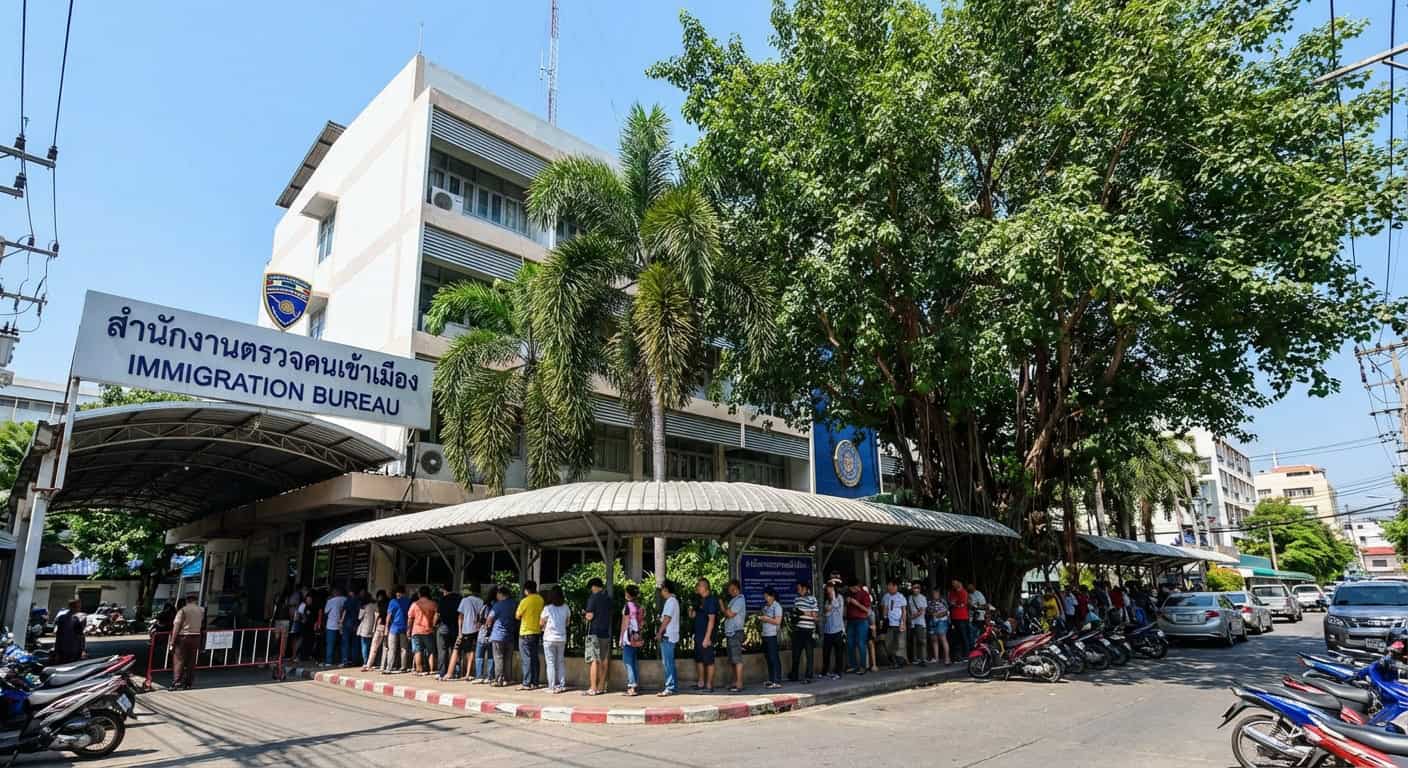
Option one: extend at immigration. You can extend your stay once at a Thai immigration office for 1,900 THB, which adds another period to your current entry. This involves a trip to an immigration office (Chaeng Watthana in Bangkok is the busiest and most chaotic), queuing for hours, filling out paperwork, and hoping everything processes smoothly. Some people find this perfectly fine. Others would rather fly to Vietnam.
Option two: the “border bounce.” Most DTV holders prefer this. Leave Thailand, even for a day, and come back. Your 180-day clock resets immediately. The popular strategy is to spend 179 days in Thailand, then take a cheap flight to Kuala Lumpur, Da Nang, or Bali for a week or two, then return to Thailand with a fresh 180 days. Many nomads build this into their calendar as a feature: five months in Chiang Mai, three weeks exploring Vietnam, back to Bangkok for another stretch.
The savvy play is combining your border bounce with exploring other countries. Your visa run becomes a travel opportunity, not a bureaucratic chore.
Before the DTV: how it used to be
To appreciate what the DTV offers, you need to understand what Thailand was like for nomads before mid-2024.
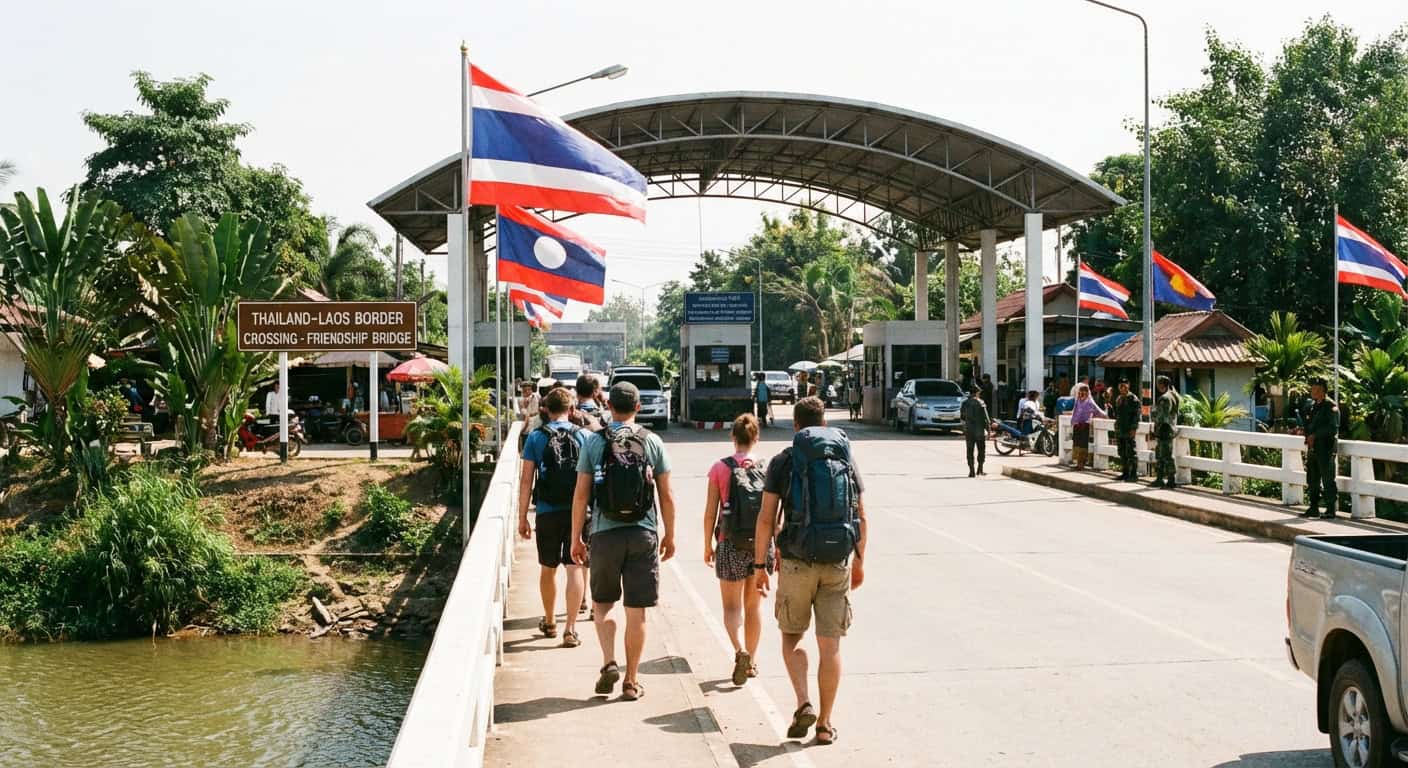
The tourist visa shuffle: Most nomads entered on a 60-day visa exemption, extended it for 30 days at immigration ($17 USD), then did a border run to restart the cycle. Every 90 days, you were on a bus to the Laos or Cambodia border. After multiple entries, immigration officers started asking pointed questions. Some people got turned away.
Education visas: The grey-market solution. Sign up for “Thai language classes” or “Muay Thai training” at a visa mill, get a 1-year education visa, and attend class once a month (or never). Thai authorities cracked down on these repeatedly, and the anxiety of holding one was constant. You never knew if your school would get shut down and your visa voided.
The Thailand Elite Visa: The nuclear option. Pay $25,000 or more for a 5 to 20-year visa with VIP immigration lanes and concierge service. Genuinely wonderful for wealthy retirees. Absurdly overpriced for a freelance developer making $4,000 a month. The DTV made this almost obsolete for working nomads.
The LTR Visa: Thailand’s Long Term Resident visa offers a 10-year stay with potential tax benefits (17% flat rate or exemption). But it targets high earners ($80,000+ per year) and has stricter requirements. If you’re at that income level, it’s worth investigating. For most nomads, the DTV is the right fit.
Living on a DTV: practical tips
Banking is the biggest headache. Opening a Thai bank account without a work permit is extremely difficult. DTV holders exist in a frustrating grey area: you’re not a tourist, but you don’t have a work permit. I’ve heard from nomads who visited five different bank branches (Bangkok Bank, SCB) and were rejected at every one. Your best bet is Bangkok Bank’s head office on Silom in Bangkok, or agent-assisted branches in Chiang Mai that are more accustomed to dealing with foreign residents. Success is possible but not guaranteed. Plan to rely on Wise, Revolut, or international cards as your primary financial tools.
Health insurance is important. The DTV does not require health insurance, but Thailand will not cover you under any public health system. Get proper international health insurance before you arrive. SafetyWing and World Nomads are popular choices in the nomad community. Thai private hospitals are excellent and affordable by Western standards, but a serious accident or illness without insurance can still generate a devastating bill. Our travel safety guide covers insurance basics in more depth.
The tax question is real. If you stay 180 or more days in Thailand in a single calendar year, you’re technically a Thai tax resident. Under rules updated in 2024 and 2025, foreign income is taxable if remitted to Thailand in the same year it’s earned. There’s ongoing debate about whether spending on a foreign credit card counts as “remitting” income. Most nomads manage this by staying 179 days maximum per calendar year, then spending the rest of the year elsewhere. As one person put it: “The DTV is a visa, not a tax shield.” If you’re earning significant income, consult a tax professional.
For staying productive, Thailand’s infrastructure makes remote work effortless. Fast internet, reliable power, abundant coworking spaces, and a daily rhythm that supports deep focus in the morning and exploration in the evening.
Chiang Mai and Bangkok: DTV hotspots
The DTV lets you live anywhere in Thailand, but two cities dominate the nomad scene.
Chiang Mai is where the Southeast Asian nomad movement started. The old city and Nimman neighborhood are full of coworking spaces, cafes, and a nomad community that’s been building for over a decade. The cost of living is lower than Bangkok, the pace is gentler, and the mountains provide a welcome change from beach-town monotony. The coworking scene is mature, from quiet focused spaces to buzzing social hubs. One major caveat: avoid February through April. Burning season fills the air with hazardous smoke, and the AQI regularly exceeds 200. Smart nomads leave Chiang Mai during burning season and return when the rains clear the air in May.
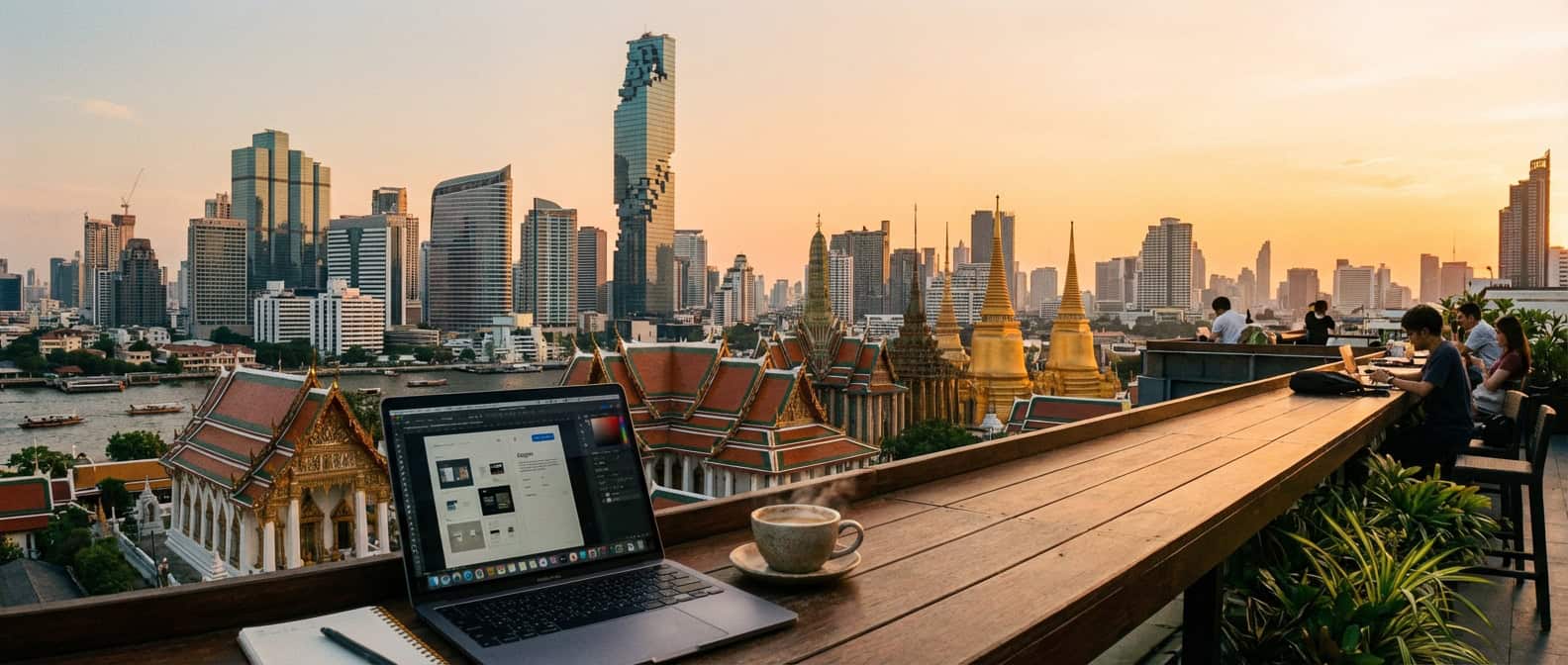
Bangkok is the opposite energy. Massive, chaotic, always stimulating. The nomad scene is more dispersed but growing fast, concentrated in areas like Ari, Thonglor, and the old town around Khao San. Bangkok has excellent healthcare, international flights everywhere, and a food scene that never stops surprising you. It’s more expensive than Chiang Mai but still very affordable by global standards. If you need a big city with serious infrastructure, Bangkok delivers.
Many DTV holders split their time: cool season in Chiang Mai (November through February), then Bangkok or the southern islands for the rest. The DTV’s flexibility makes these internal moves effortless since you don’t need to report address changes to immigration.
Continue your journey
If Thailand is your move, these guides will help you hit the ground running:
- The Digital Nomad Guide to Chiang Mai — neighborhoods, coworking, community, and everything you need for Thailand’s mountain capital
- Chiang Mai Cost of Living for Digital Nomads — monthly budget breakdown, rent averages, and where your money goes
- Best Coworking Spaces and Cafes in Chiang Mai — tested wifi speeds, pricing, and honest reviews
- The Complete SE Asia Visa Guide — compare Thailand’s DTV against every other option in the region
- Visa Runs and Border Crossings in SE Asia — the practical guide to your 180-day exit strategy
- Vietnam Visa Guide — if Vietnam is your border bounce destination, know the visa rules before you fly
- Bali and Indonesia Visa Guide — the other major SE Asia nomad visa option
The bottom line
The DTV turned Thailand from a visa headache into the easiest long-term stay in Southeast Asia. For $300 and a few documents, you get five years of access to a country with excellent infrastructure, great food, a large nomad community, and a cost of living that lets you save money while living well. The application is straightforward if you follow the steps. The lifestyle is proven. The community is waiting.
If you’re looking for people to share the experience with, whether it’s finding a coworking buddy in Chiang Mai, splitting a Muay Thai gym membership, or just having someone to explore the night markets with, HitchHive connects you with other nomads and travelers in Thailand. Some of my best friendships here started with a random message from someone who’d just landed and was looking for the same things I was. The visa gets you in the door. The people make you stay.
If you’re weighing Thailand against the rest of the region, the SE Asia visa comparison and our broader digital nomad guide will help you make the call. But honestly? For most remote workers, Thailand and the DTV is the answer. The rest is just details.
Leave a Reply