

Bali is the dream. The visa situation is the wake-up call.
Everyone pictures the same thing when they think about being a digital nomad in Bali. Laptop open at a rice-paddy cafe, frangipani in the air, a smoothie bowl within arm’s reach, surf break at sunset. And honestly, Bali delivers on that fantasy better than almost anywhere else on the planet. What nobody mentions in the Instagram captions is the visa situation, which is more layered, more confusing, and more consequential than most nomads realize until they’re already on the ground.
Indonesia doesn’t have a single, clean “digital nomad visa” the way Thailand does with its DTV. What it has is a menu of options, each with different costs, time limits, restrictions, and trade-offs. The right choice depends on how long you want to stay, how much you earn, and how much bureaucracy you’re willing to tolerate. I’ve been through this system across multiple stays, and this guide breaks down every realistic option so you can pick the right path before you land.
Visa options overview
Let me lay out the full picture before we go into each one. Indonesia offers five main visa paths that are relevant to digital nomads, but only two or three of them make practical sense for most people.
The Visa on Arrival (VoA) gets you 30 days with one possible extension to 60. Cheapest and simplest. The B211A Social/Visit Visa gives you 60 days with two extensions totaling up to 180 days, and it’s the workhorse visa that most long-term nomads use. The E33G Remote Worker Visa is the newer option offering a full year with multiple entries, but it requires proving $60,000 or more in annual income. There’s also the Second Home Visa, which requires a $130,000 bank deposit and is designed for wealthy retirees, not working nomads. And the Investor KITAS, which involves setting up an Indonesian company and is only relevant if you’re actually doing business locally.
For the vast majority of digital nomads, the real decision comes down to: VoA for short trips, B211A for the standard Bali stint, or E33G if you’re a higher earner who wants maximum flexibility. Everything else is niche. If you’re comparing Bali’s options against the rest of the region, the Southeast Asia visa guide puts all the countries side by side.
The B211A: the de facto digital nomad visa
The B211A is what most nomads in Bali are on, whether they know the official name or not. It’s technically called a “Visit” or “Social” visa, not a work visa. Remote work falls into a grey area that Indonesia tolerates but doesn’t explicitly authorize. More on that later.
Here’s how it works. You apply through a visa agent while you’re outside Indonesia. This is non-negotiable. The onshore application option that existed during the pandemic was killed in mid-2023. You must be offshore when you apply. The agent acts as your local sponsor, which is a legal requirement. They handle the paperwork, you get a visa PDF, and you fly in.
The initial grant is 60 days. After that, you can extend twice, each extension adding another 60 days, for a maximum total of 180 days (six months). Extensions require a trip to the immigration office. You’ll go through biometrics, photos, fingerprints. It’s not complicated, but it’s time-consuming if you do it yourself.
The single-entry catch: The B211A is single entry. If you leave Indonesia for any reason, even a weekend trip to Singapore, your visa is cancelled. You’d need to apply for a completely new B211A from outside the country. This is the B211A’s biggest limitation and the main reason some higher earners opt for the E33G instead.
Cost through an agent runs $200 to $350 for the initial visa, plus $50 to $80 per extension. Budget about $300 to $500 total for a full six-month stay including all extensions. That’s remarkably cheap for half a year in paradise.
Visa on arrival: the quick option
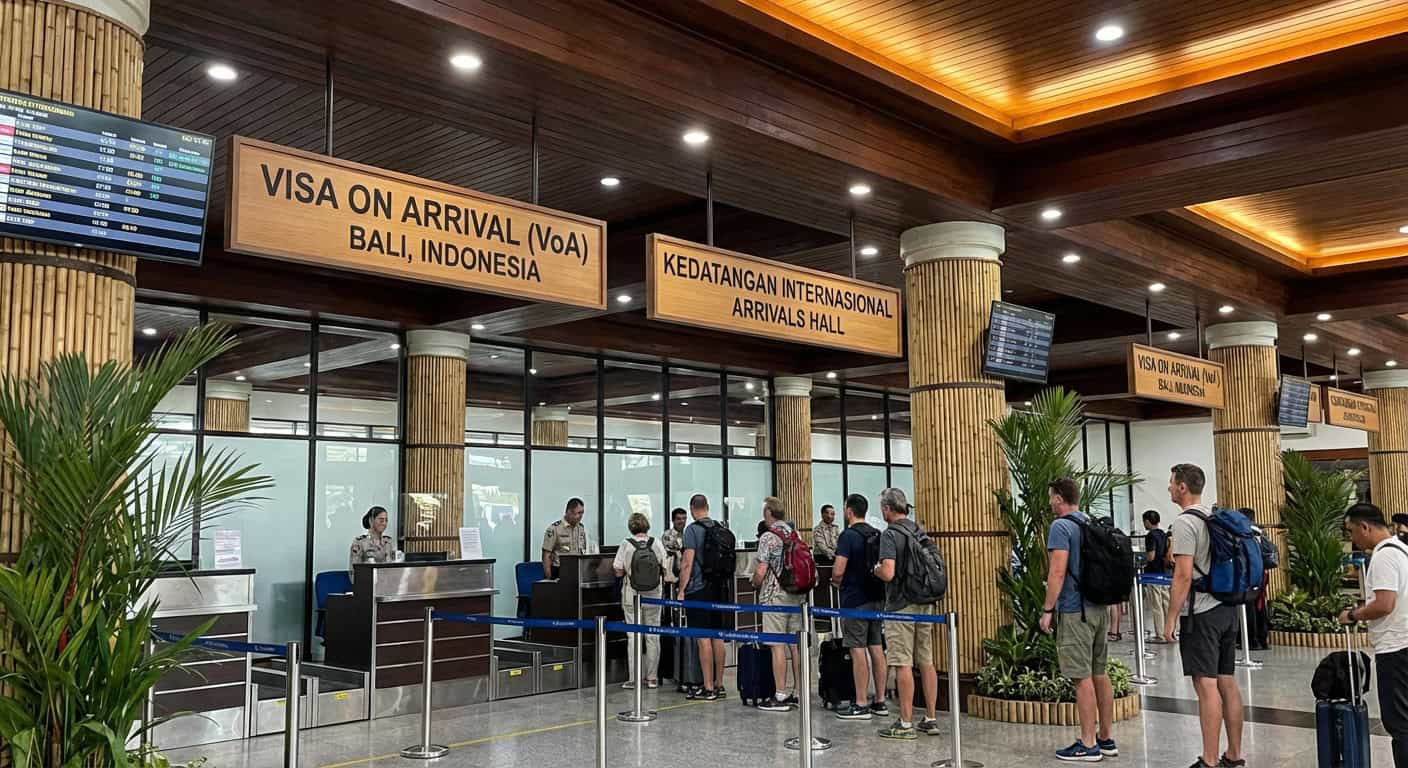
If you’re coming to Bali for under two months, the Visa on Arrival is the path of least resistance. You can buy it online as an e-VoA before you fly (recommended, skips the airport queue) or pay at the immigration counter when you land. Cost is 500,000 IDR, roughly $32.
The VoA gives you 30 days. You can extend it once for another 30 days, totaling 60 days max. The extension process is the same immigration office visit as the B211A: forms, biometrics, waiting. An agent can handle it for about 800,000 to 1,000,000 IDR.
The VoA is perfect for testing the waters. Come for a month, see if Bali suits your work rhythm, and if you love it, start planning your B211A for the next trip. Don’t try to extend beyond 60 days on a VoA. It’s not possible, and overstaying carries a brutal penalty of 1,000,000 IDR ($65) per day. That adds up terrifyingly fast.
Indonesia’s remote worker visa (E33G)
The E33G is Indonesia’s answer to the global digital nomad visa trend. Launched in 2024, it offers a full year with multiple entries, meaning you can fly in and out of Indonesia freely without killing your visa. For nomads who want Bali as a home base but also travel around the region regularly, this is a major upgrade over the B211A.
The catch: you need to prove annual income of at least $60,000 USD and provide an employment contract or proof of freelance income. The application process is more involved than the B211A, and most people need an agent to get through it. Costs run $650 to $1,000 or more through an agent. You’ll also get a KITAS (temporary residency permit), which lets you open a local Indonesian bank account.
There’s a significant tax consideration with the E33G. The visa itself provides a specific exemption from Indonesian taxes on foreign-sourced income. That’s a real benefit. But here’s the nuance: if you stay in Indonesia for more than 183 days in any 12-month period, you become an Indonesian tax resident regardless of your visa type. The E33G protects your foreign income from Indonesian tax, but crossing that 183-day line still creates obligations that are worth discussing with a tax professional.
My honest take: the E33G makes sense if you earn well above $60,000, you want to stay a full year, and you value the freedom to pop in and out for trips to Vietnam, Thailand, or anywhere else without losing your visa. For everyone else, the B211A is simpler, cheaper, and sufficient.
Using a visa agent: why almost everyone does
Unlike Vietnam where you can handle everything yourself on a government website, Indonesia’s visa system practically requires an agent for anything beyond a basic VoA. The B211A needs a local sponsor, and unless you have an Indonesian friend willing to sponsor you (and deal with the paperwork), an agent is your sponsor.
Good agents handle everything. They submit your application, act as your sponsor, send you the visa PDF, and manage your extensions. For extensions, many offer courier service where they pick up your passport from your villa, take it to immigration, and bring it back. You only need to show up at the immigration office once for biometrics.
The names that come up repeatedly in Bali’s nomad community are Gaya Bali Visa (highly responsive, transparent pricing, great WhatsApp communication), Bali Business Consulting (long-standing reputation), and Lets Move Indonesia (larger operation, professional but pricier). Any of these are safe bets.
Red flags to watch for: Agents offering suspiciously low prices on Instagram often ghost you when extension time comes. Anyone asking for “quarantine fees” or “COVID test fees” is running an outdated scam. And if an agent can’t clearly explain the timeline and costs upfront, find a different one. The cost difference between a cheap agent and a reputable one is $50 to $100. The peace of mind is worth ten times that.
One tip that surprises first-timers: dress appropriately for the immigration office. Long pants and closed-toe shoes. If you show up in flip-flops and board shorts, they will turn you away at the door. I’ve seen it happen. It’s Indonesia, not your living room.
Visa runs from Bali
If you max out your B211A at 180 days or simply need a fresh visa, you’ll need to leave Indonesia and apply for a new one from offshore. This is the Bali visa run, and it’s a well-worn path.
Kuala Lumpur is the top pick. Cheap flights from Bali, Malaysia gives free 90-day entry to most Western passports, and the airport is efficient. KL is also a genuinely enjoyable city to spend a few days in while you wait for your new B211A to process. The food alone makes the trip worthwhile.
Singapore works well logistically but costs more for food and accommodation. If you’re doing a quick three-day turnaround, the extra cost stings. If you’re turning the run into a proper trip, Singapore is fantastic.
Bangkok is another solid option with good flight connections. Slightly more expensive than KL for flights from Bali but offers more variety if you want to extend your run into a mini-vacation.
Critical rule: Do not return to Indonesia on the same day you left. Spend at least 24 to 48 hours in your visa run destination. Immigration flags same-day returns as suspicious, and getting questioned or denied entry at the border is not how you want to start your next 60 days. For a breakdown of every visa run route in the region, including costs and timing, the visa runs and border crossings guide covers it all.
Also, and this is critical: you need a confirmed onward flight out of Indonesia within 60 days of your entry date. Immigration checks this religiously now. If you don’t have firm plans, services like OnwardTicket.com generate a valid booking that satisfies the requirement without committing you to a specific flight.

Where to base in Bali
Your neighborhood choice in Bali shapes your daily experience more dramatically than in most nomad cities, because the island’s areas feel like completely different worlds.
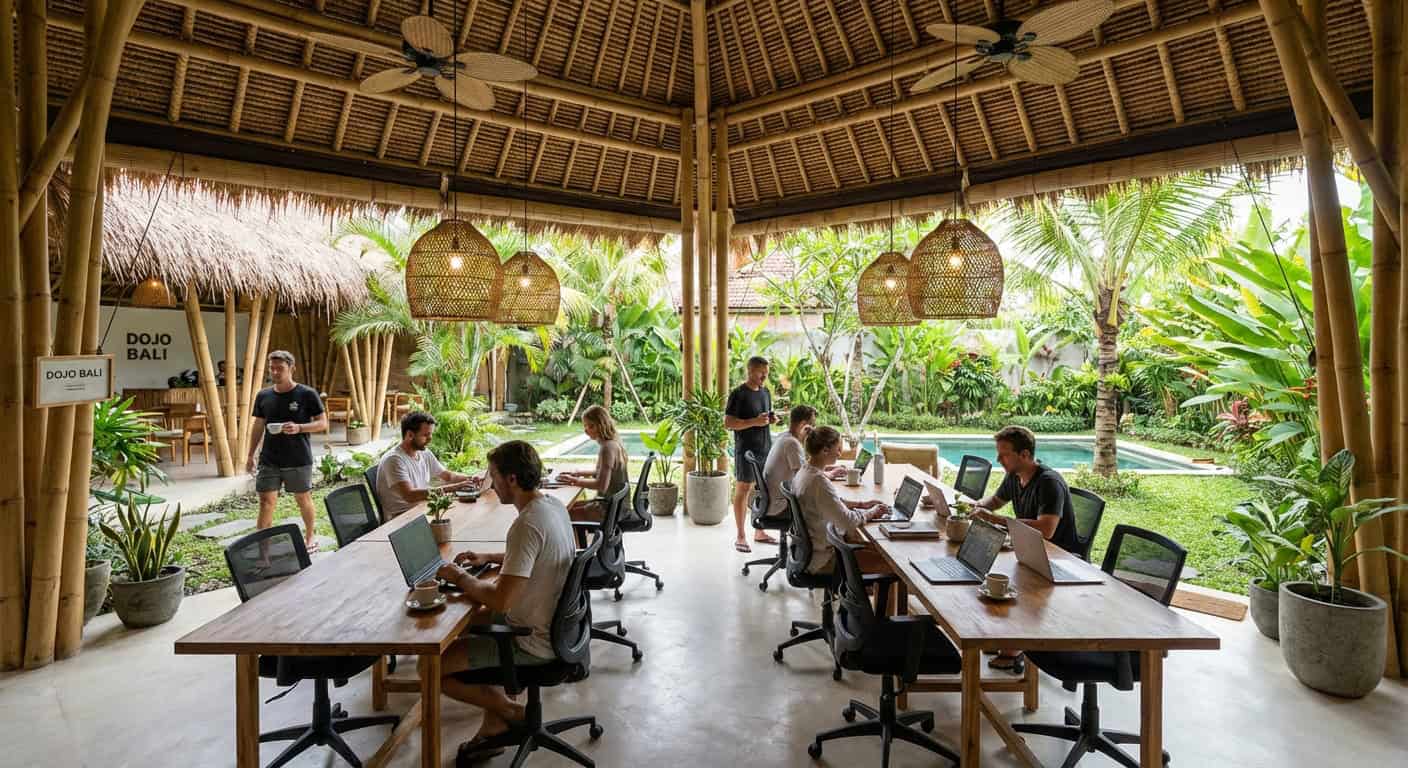
Canggu is the nomad capital. It has the highest concentration of coworking spaces, cafes, restaurants, and fellow remote workers. Tropical Nomad and Dojo Bali are the anchor coworking spots. The social scene is massive and easy to plug into. The downsides are real, though: traffic has become a genuine nightmare, prices have crept up to where Canggu is no longer a “cheap” destination, and the vibe can feel more like a digital nomad theme park than an authentic Balinese experience. If you want community and convenience above all else, Canggu delivers.
Ubud is Canggu’s spiritual counterpart. Inland, surrounded by rice terraces and jungle, with a slower pace and deeper connection to Balinese culture. The yoga and wellness scene is massive. Coworking options exist but are fewer. If you need the beach, Ubud isn’t your spot. If you need peace, creativity, and a morning walk through emerald-green rice paddies, it absolutely is.
Sanur is the quieter, more local-feeling beach town on the east coast. Lower prices, less traffic, calmer energy. The nomad community is smaller but tighter. If you’ve been traveling through Southeast Asia for a while and you’re tired of the party-and-hustle scene, Sanur is a relief. Some nomads call it “boring.” I’d call it mature.
For a broader perspective on how Bali stacks up against other nomad destinations worldwide, the best cities for digital nomads ranking puts it in context.
Tax and legal considerations
Let’s address the elephant in the coworking space. Working remotely on a tourist visa in Indonesia is technically not legal. The B211A and VoA do not authorize any form of work. In practice, Indonesia distinguishes between foreigners taking local jobs (which they actively enforce against) and foreigners working remotely for foreign clients, paid into foreign bank accounts (which they largely ignore).
The enforcement targets are clear: foreigners who teach yoga without a work permit, surf instructors, photographers selling services to Bali tourists, DJs, villa promoters. Anyone visibly competing with local workers. If you’re quietly writing code for a company in Berlin from a Canggu coworking space, you’re in the category that Indonesia has historically shown no interest in pursuing.
That said, the rules exist, and they could be enforced at any time. The smart approach: don’t tell immigration you’re coming to work (say “tourism” or “holiday”), don’t post on social media about “working from Bali,” don’t get paid in Indonesian Rupiah, and don’t advertise local services. Coworking spaces are considered safe zones. Immigration raids on coworking spaces are extremely rare, nearly unheard of. The spaces operate openly and have relationships with local authorities.
On taxes: if you spend more than 183 days in Indonesia within any 12-month period, you technically become an Indonesian tax resident. Indonesia has been moving toward worldwide income taxation for residents. Enforcement on nomads without a local tax ID is very difficult and rarely pursued, but it’s a real legal risk if you stay long-term. The safe play is to keep your total annual days in Indonesia under 183 if you don’t want to deal with the tax system. If you plan to stay longer, get a tax consultant. This is not an area where “she’ll be right” is a responsible strategy.
Practical tips for daily life
Internet: Good in coworking spaces, inconsistent in private villas. Fiber optic is becoming standard in newer developments, but power outages still happen. Always have a mobile hotspot as backup. Telkomsel is the strongest carrier for data coverage across the island. If staying productive on the road is your priority, coworking spaces are more reliable than trying to depend on villa wifi for important calls.
Banking: Indonesia is still heavy on cash for everyday transactions, especially outside the tourist bubbles. ATMs are plentiful but have low withdrawal limits. Wise (formerly TransferWise) is the nomad standard for getting money in and out efficiently. Some restaurants and cafes in Canggu accept card payments, but always carry cash.
Health insurance: Non-negotiable. Indonesian hospitals range from excellent private facilities (BIMC, Siloam) to basic local clinics. A medical emergency without insurance can be financially devastating, and medical evacuation to Singapore (which serious cases sometimes require) costs five figures. SafetyWing and World Nomads are popular options in the community. Check our travel safety guide for detailed coverage comparisons.
Coworking: Beyond Dojo and Tropical Nomad in Canggu, newer spaces are popping up in Uluwatu, Ubud, and Sanur. Day passes typically run $10 to $15, monthly memberships $100 to $200. Most include decent coffee, fast wifi, and air conditioning. The social value alone is worth the membership fee. If building your nomad community matters to you, coworking spaces are where it happens in Bali.
Scooters: You will need one. Bali’s public transport is effectively non-existent, and Grab coverage is spotty outside major tourist areas. Monthly scooter rentals run $50 to $80. Get an International Driving Permit from your home country before you come. Police checkpoints are common, and fines for riding without a valid license are a regular occurrence. More importantly, Bali’s roads are genuinely dangerous. Ride carefully, wear a helmet, and don’t drive at night if you can avoid it. Our budget travel guide has more tips on keeping transport costs low across Southeast Asia.

Continue your journey
Bali is one stop on the Southeast Asian circuit. These guides fill in the rest of the picture:
- The Complete Southeast Asia Visa Guide for Digital Nomads — every country, every visa type, one overview
- Thailand’s Digital Nomad Visa (DTV) — the purpose-built option for remote workers in Thailand
- Vietnam Visa for Digital Nomads: The 90-Day E-Visa Strategy Guide — Vietnam’s simpler but effective system
- Visa Runs and Border Crossings in Southeast Asia — every route, every cost, every tip for moving between countries
- The Complete Digital Nomad Guide — if you’re just getting started with remote work abroad
Start your Bali chapter
Bali’s visa situation is more complex than Vietnam’s or Thailand’s, but it’s entirely manageable once you understand the options. The B211A gets most nomads exactly what they need: six months in one of the world’s most compelling places to live and work remotely. The E33G exists for those who want more flexibility and can meet the income threshold. And the VoA is always there for a quick test run.
The key is preparation. Choose your visa before you book your flight, find a reputable agent, apply from offshore, and set calendar reminders for every deadline. Indonesia’s overstay fines are brutal, and the system has no mercy for “I forgot.” But do it right, and Bali rewards you with a quality of life that’s hard to match anywhere else on the nomad circuit.
If you’re heading to Bali and want to plug into the community before you land, check out HitchHive. Connecting with nomads who’ve already figured out the visa maze, found the best agents, and know which coworking space actually has reliable wifi can save you weeks of figuring things out on your own. See you in the rice paddies.
Leave a Reply